
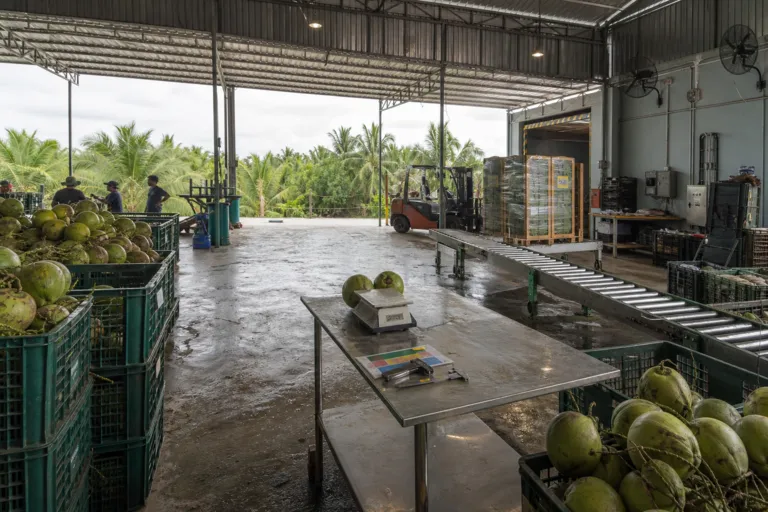
Vietnam’s coconut story has shifted from a traditional crop to a fast-moving export industry. In 2025, the total value of Vietnam’s coconut exports reached USD 534 million, up 37% year on year, according to Vietnam export and customs data. Another report based on Customs Department statistics puts 2025 export revenue at more than USD 533 million, an increase of over 36% versus the prior year. Export volume is also cited at 48.26 thousand tons in 2025 under HS code 080119. These gains are tied to rising demand for tropical agricultural products and for processed coconut goods such as coconut water, desiccated coconut, coconut milk, and coconut oil.
Behind the export push sits a large raw-material base and a growing processing ecosystem. Vietnam has over 200,000 hectares of coconut plantations, and annual coconut production exceeds 2.1 million tons, according to the Ministry of Agriculture and Environment. Cultivation is concentrated in southern provinces including Ben Tre, Tra Vinh, Tien Giang, Vinh Long, and Soc Trang, with Ben Tre widely recognized as the country’s “coconut capital.” Exporters increasingly sell beyond raw fruit. Vietnam currently exports more than 100 coconut-based products, spanning coconut oil, canned coconut water, desiccated coconut, coconut fiber, activated carbon, and agricultural growing media.
China And the US: The Two Breakout Gateways
Market access has been a turning point, especially in China. Since mid-August 2024, fresh Vietnamese coconuts have been officially allowed to enter China through formal trade channels, opening a larger, more regulated pathway for growth. China is described as among the world’s largest coconut-consuming countries, with annual consumption around 4 billion coconuts, including about 2.6 billion fresh coconuts. Vietnam’s own exposure is already meaningful. One source notes that China currently accounts for about 30%–35% of Vietnam’s coconut export turnover, while an IndexBox market report states that China comprises 55% of Vietnam’s coconut export value, with Thailand second at 21%.
While China is central for coconuts overall, the United States stands out for value-added coconut oil. In Vietnam’s coconut (copra) oil exports, the United States is the key foreign market in value terms, comprising 55% of total exports, according to IndexBox. Canada holds 16%, followed by China at 9.7%. This split highlights how the Vietnam coconut export market is not just about where fresh fruit goes, but also where processed categories win premium shelf space. It also underscores why deep processing and product diversification matter as much as farm output when exporters target different buyers and standards.
Policy and compliance steps are now shaping the next phase. Coconuts are one of Vietnam’s six priority industrial crops under the national development plan for key industrial crops through 2030, a position that can accelerate investment in raw-material areas, processing facilities, logistics, and trade promotion. China’s General Administration of Customs approved six additional planting areas and packaging facility codes for An Giang province, aimed at supporting deeper access for fresh coconuts. The move comes alongside a broader push for traceability and standardized sourcing. With exports of four key product groups bringing in over USD 520 million in the first half of 2025, up more than 20% year on year, the sector is building momentum that reaches beyond a single market channel.
How big were Vietnam’s coconut exports in 2025?
When did fresh Vietnamese coconuts officially enter China via formal trade channels?
What share of Vietnam’s coconut export value goes to China?
Why is the US important for Vietnam’s coconut oil exports?
What is changing in the Vietnam coconut export market besides raw coconuts?