

Vietnam Africa trade increasingly links African agricultural and mineral resources with Vietnamese processing industries and international business capabilities. Cashews, copper, and telecommunications demonstrate how the relationship is expanding beyond conventional merchandise trade.
ASEAN–Africa: The Next Corridor, developed by Eurogroup Consulting in collaboration with the Alliance des Patronats Francophones (APF) and the Cambodia Chamber of Commerce (CCC), examines these emerging connections.
Launched at REF 2026 in Phnom Penh on 14 November, the whitepaper highlights Vietnam's role in agricultural processing, industrial supply chains, and telecommunications development across African markets.
For Vietnamese businesses, the opportunity lies in combining established capabilities with reliable sourcing relationships and long-term commercial partnerships.
Why Is Vietnam Central to Africa's Cashew Trade?
Vietnam is an important global center for cashew processing, sourcing substantial quantities of raw nuts from African producers.
According to the whitepaper, Vietnam imported approximately US$4.5 billion in cashews in 2025, drawing on suppliers including Côte d'Ivoire, Nigeria, and Ghana.
The relationship connects African agricultural production with Vietnamese processing expertise and international distribution networks.
However, the structure of the industry is evolving.
African producing countries are expanding domestic processing activities to retain greater value locally.
Côte d'Ivoire, for example, increased local cashew processing to approximately 344,000 tonnes in 2024, according to figures presented in the report.
This creates new questions for Vietnamese companies concerning sourcing, processing location, and cross-regional partnerships.
The ASEAN–Africa: The Next Corridor whitepaper examines how agricultural value chains could distribute more economic activity across both regions.
From Commodity Sourcing to Integrated Food Businesses
Agricultural cooperation can generate additional value when sourcing, processing, logistics, and distribution are connected.
The whitepaper highlights ETG as an example of this approach.
The international agribusiness group operates across African agricultural markets while maintaining processing activities in both Africa and Vietnam.
Its cashew operations combine relationships with farmers and suppliers, storage infrastructure, processing facilities, and international marketing.
The company's African logistics platform comprises more than 475 operational facilities, according to the whitepaper.
This integrated approach demonstrates how businesses can create value beyond buying and selling raw commodities.
For Vietnamese companies, several considerations are particularly relevant:
- Supply reliability: Develop relationships with credible African producers and aggregators.
- Processing economics: Compare production costs, energy access, and technical capabilities across locations.
- Quality requirements: Maintain product standards and traceability throughout the value chain.
- Distribution strategy: Identify markets where processed products can achieve competitive positioning.
These factors influence where investment and processing activities can generate sustainable returns.

Read more about this wider transformation in How Vietnam's Cashew Exporters Are Moving Up the Value Chain.
African Minerals Support Vietnam's Industrial Ecosystem
Vietnam's economic relationship with Africa also extends into industrial materials.
African copper and cobalt help supply Southeast Asian electronics and manufacturing industries.
According to Harvard Atlas of Economic Complexity data cited in the whitepaper, approximately US$0.8 billion in copper and cobalt flows from Africa to ASEAN, with Vietnam receiving the largest share.
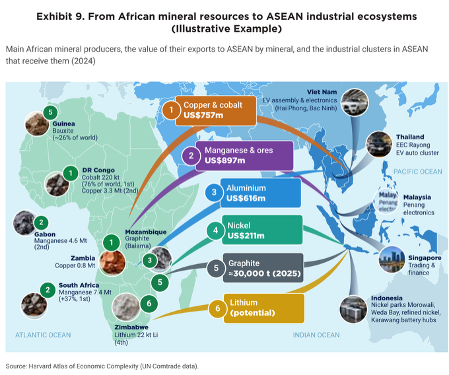
These materials connect African mineral production with Vietnamese industrial clusters involved in electronics and electric-vehicle-related manufacturing.
However, reliable sourcing requires more than access to mineral resources.
Companies must evaluate product specifications, logistics costs, supplier capabilities, and long-term industrial demand.
Potential opportunities include supply agreements, processing partnerships, and industrial cooperation where commercial conditions support investment.
The strategic priority is identifying which activities can generate competitive value across the supply chain.
Viettel's African Experience Demonstrates a Different Expansion Model
Vietnam's commercial presence in Africa is not limited to agriculture or manufacturing.
Viettel operates telecommunications businesses in Mozambique, Tanzania, and Burundi through the Movitel, Halotel, and Lumitel brands.
These operations demonstrate how Vietnamese companies can develop local services, infrastructure, and customer relationships in African markets.
Rather than entering solely as a technology exporter, Viettel has established operating businesses adapted to local conditions.
Nguyen Thi Hoa, Chief Executive Officer of Viettel Global, emphasizes the importance of lasting relationships in the whitepaper:
"In the end, the success of ASEAN–Africa cooperation will be measured not by how many opportunities we identify, but by how many become lasting partnerships."
Her perspective highlights the need for commercial commitment beyond initial market entry.
For Vietnamese companies, the experience provides a useful example of adapting operating capabilities to different markets.
What Should Vietnamese Companies Consider Before Expanding?
Vietnam's economic relationships with Africa create opportunities across several industries.
However, the most appropriate expansion strategy depends on commercial demand and operating requirements.
Businesses should evaluate:
- Sector alignment: Determine where Vietnamese capabilities match African market needs.
- Partner selection: Assess suppliers, distributors, technical partners, and local operators.
- Entry structure: Compare exports, distribution agreements, processing partnerships, and direct investment.
- Execution risks: Review financing, regulation, infrastructure, and supply-chain reliability.
These considerations help distinguish viable projects from opportunities that remain commercially uncertain.
For companies assessing international expansion, Vietnam market research and strategic consulting can support market selection, partner assessment, and investment planning.
Frequently Asked Questions
Why is Africa important to Vietnam's cashew industry?
African countries supply significant quantities of raw cashews for processing in Vietnam. This relationship connects agricultural production with Vietnamese industrial capabilities and international distribution. As African producers develop domestic processing, opportunities may emerge for more integrated partnerships involving sourcing, technology, and manufacturing.
Is Africa increasing its own cashew-processing capacity?
Yes. The whitepaper highlights increasing processing activity in Côte d'Ivoire, one of Vietnam's important cashew suppliers. This reflects efforts to retain more value within African agricultural economies. However, processing competitiveness depends on energy costs, infrastructure, quality standards, and access to international markets.
What minerals does Vietnam source from Africa?
African copper and cobalt supply industrial activities across ASEAN, particularly in Vietnam. These materials support electronics and related manufacturing industries. Commercial opportunities depend on mineral specifications, pricing, supply reliability, transport arrangements, and the availability of suitable processing capabilities.
Which Vietnamese telecommunications company operates in Africa?
Viettel operates telecommunications businesses in Mozambique, Tanzania, and Burundi under the Movitel, Halotel, and Lumitel brands. Its African activities demonstrate how Vietnamese technical capabilities can be adapted through local infrastructure development, market knowledge, and long-term operating partnerships.
Discover Vietnam's Expanding Economic Links With Africa
Vietnam's agricultural, industrial, and telecommunications capabilities provide opportunities for stronger partnerships with African businesses.
For executives exploring these relationships, the full whitepaper offers detailed analysis of cross-regional value chains, company experiences, and commercial opportunities through 2035.