
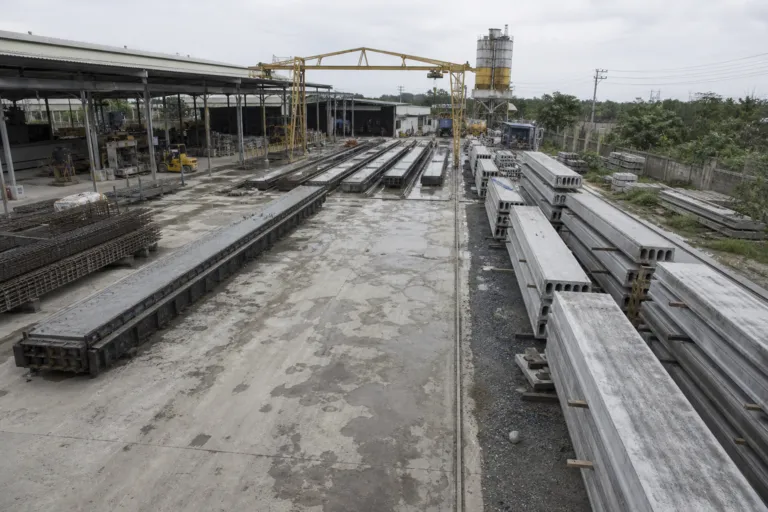
Vietnam’s construction pipeline is increasingly rewarding building methods that reduce on-site work and shorten schedules. Multiple market reports describe a clear move toward factory-made systems, including precast concrete elements produced in controlled conditions and assembled on site. IMARC Group defines precast concrete as being manufactured off-site and notes that controlled production reduces the likelihood of defects and supports consistent quality, while still allowing customization in shapes, finishes, and textures. This quality-and-speed value proposition is showing up in demand across industrial buildings, housing, and public facilities, and it is one reason Vietnam’s precast concrete market reached USD 577.4 million in 2025, with IMARC projecting USD 1,064.2 million by 2034 at a 6.82% CAGR during 2026–2034.
Industrial investment is a major tailwind for precast usage because factories and warehouses need repeatable foundations and standardized structural systems. Nexdigm reports that Vietnam recorded USD 25.58 billion of registered foreign investment in manufacturing and processing and USD 6.31 billion in real estate, strengthening construction demand for piles, structural members, and factory-produced concrete systems. The same source also notes realized foreign investment across Vietnam at USD 25.35 billion and 3,375 newly approved foreign-invested projects, supporting a broad project pipeline. Demand hotspots are described around Hanoi, Ho Chi Minh City, Bac Ninh, Hai Phong, and Binh Duong, where industrial corridors and high-density construction make speed and logistics decisive in procurement decisions for precast components.
Why Precast Piles And Modular Systems Are Pulling Ahead
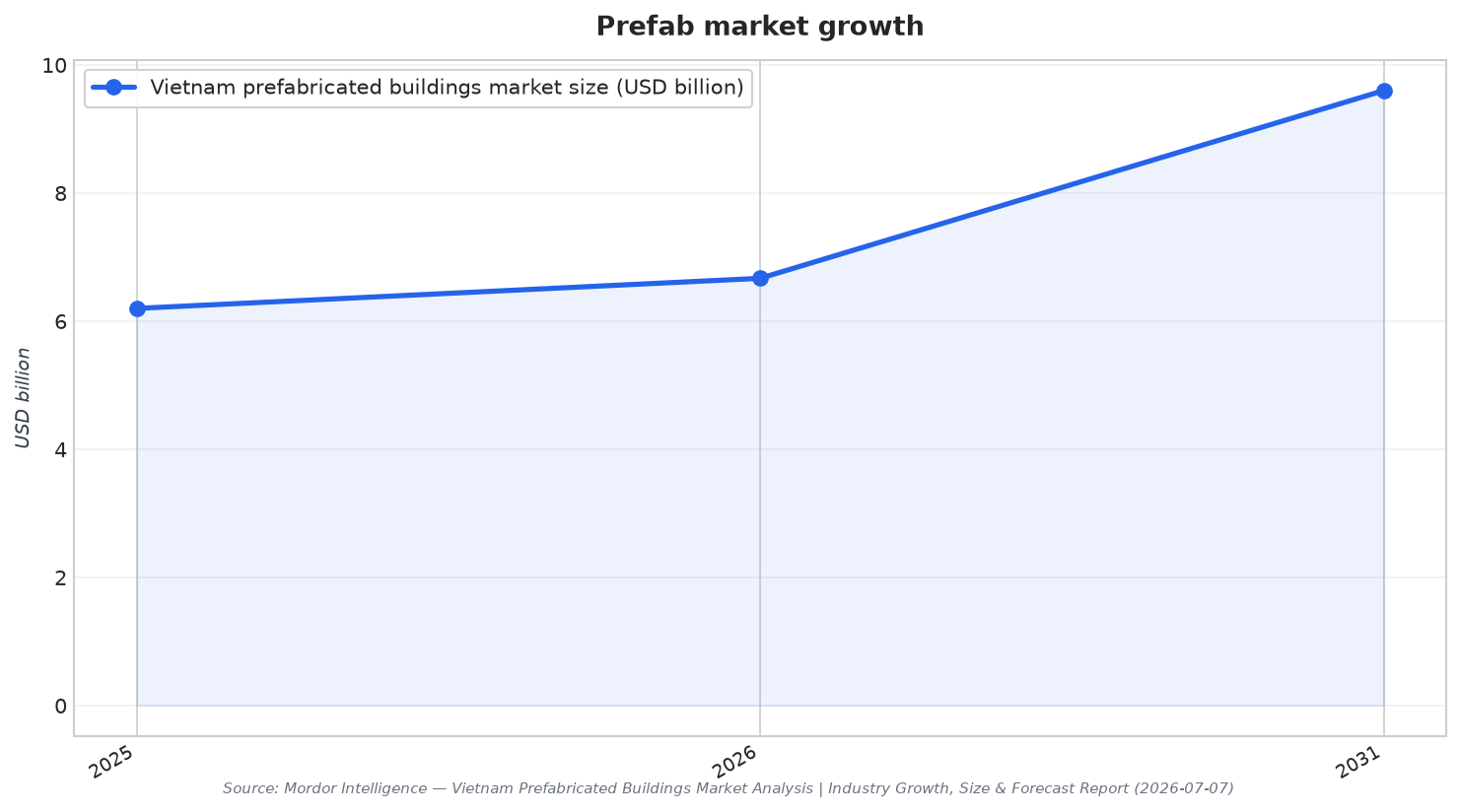
Within Vietnam precast concrete construction, piles remain a defining product because many industrial, port, residential, and infrastructure projects require engineered deep foundations. Nexdigm states that PC and PHC spun concrete piles have held a dominant position, citing standardized factory manufacturing, high compressive performance, and compatibility with pile-driving, pile-pressing, and pre-boring methods. The report also points to growing domestic capability: Phan Vu has manufactured pre-tensioned spun concrete piles since 1996, while 620 Chau Thoi operates a pipe-pile line capable of producing 500 D300–D600 piles per day. At the same time, Mordor Intelligence shows broader prefab momentum: Vietnam’s prefabricated buildings market was valued at USD 6.20 billion in 2025 and is estimated at USD 6.67 billion in 2026, with a forecast to reach USD 9.6 billion by 2031 at a 7.56% CAGR.
Housing policy and city-level demand concentration add another layer of pull for factory-built approaches that can be repeated at scale. Mordor Intelligence highlights the “One Million Social Homes 2025–2035” scheme as a key driver and reports that it has already delivered 117 schemes totaling 85,275 units, with another 159 projects aimed at 135,563 units to be handed over by end-2025. In the same prefab market dataset, concrete led with 50.78% share by material in 2025, residential projects captured 50.62% revenue share, and Ho Chi Minh City held 21.12% share in 2025. Nexdigm’s location lens complements that picture, noting Bac Ninh and Hai Phong as major demand centers, with Bac Ninh attracting USD 5.12 billion of registered FDI and Hai Phong USD 4.94 billion, while Ho Chi Minh City attracted more than USD 3.04 billion.
Contractors are also aligning their execution models around faster cycles and more integrated precast systems. MarkWide Research describes precast technology migrating from standard hollow-core flooring to integrated wall-and-facade systems that combine structural load-bearing with finished architectural surfaces. It adds that mid-rise residential developers in Hanoi are specifying these components to compress floor-cycle times from seven days to four days. The same source notes that Coteccons Construction JSC leverages its precast concrete technology leadership to differentiate on speed-to-completion. Looking ahead, IndexBox emphasizes that clearer national standards and building codes that explicitly recognize and facilitate precast construction could further accelerate adoption, especially for stakeholders that can pair product quality with reliable delivery and technical support.
How large is Vietnam’s precast concrete market today, and what is the outlook?
What is driving demand for precast in Vietnam’s industrial corridors?
Which precast products are especially important for Vietnam projects?
How is the social-housing program supporting factory-built construction?
What is changing in Vietnam precast concrete construction on-site execution?