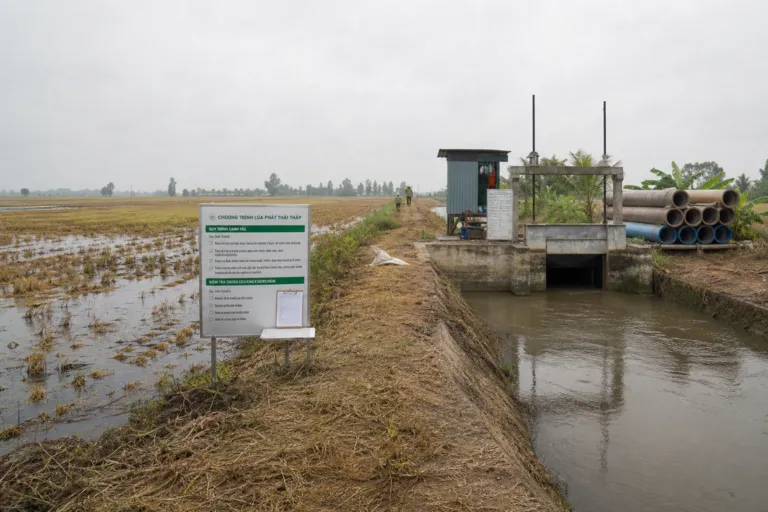
Rice sits at the center of Vietnam’s economy and food system. Vietnam contributes about 5% of global rice production, and rice feeds over 90% of the population. Yet the same crop also contributes about half of the country’s agricultural emissions, which is why policymakers and producers are now testing new production models. In the Mekong and Red River deltas, rice is cultivated at scale, but the Mekong Delta is widely described as the country’s rice heartland. This context is driving the push for a sustainable shift that keeps yields and quality competitive while cutting emissions linked to conventional practices.
The flagship effort is a government-backed project aiming for one million hectares of high-quality, low-emission rice in the Mekong River Delta by 2030. Vietnam’s agriculture ministry has collaborated with the International Rice Research Institute (IRRI) to implement pilot farming under this program, using certified and mechanised direct-seeded rice alongside advanced practices. In reported pilots, yields reached 6.3–6.5 tons per hectare, while greenhouse gas emissions were reduced by at least 2 tons. Together, these results frame the promise of the Vietnam low emission rice Mekong transition as a practical, farm-level system rather than a purely policy ambition.
From Pilot Models to Labels and Export Proof Points
Program reviews are also starting to translate into standards and market signals. At a high-level conference convened by the Ministry of Agriculture and Environment (MAE), the two-year progress of the “One Million Hectares of High-Quality, Low-Emission Rice Associated with Green Growth in the Mekong Delta by 2030” program was assessed. One reported outcome was a profit of VND 32.77 million per hectare, approximately VND 10.52 million higher than conventional methods. The Vietnam Rice Industry Association has also launched a “Vietnam Green Low-Emission Rice” label, providing a recognizable marker for verified production practices.
Certification and early trade activity show how quickly the concept is moving from fields to commercial channels. One report states that 18,086.39 hectares have been certified for rice production under the label, with potential output of 75,060 tons of rice carrying that certification. Another update notes 5,269 hectares certified as low-emission Green Vietnamese Rice, equivalent to 19,200 tons of rice, alongside broader re-organization steps such as 100% of farmers being organized into cooperatives and 100% mechanization of land preparation and sowing. The first 500 tons of certified low-emission rice were exported to Japan, a milestone used to signal the credibility of Vietnam’s emerging sustainable rice brand.
Scaling still depends on whether farmers see the gains as worth the perceived risks. A study based on survey data from 748 farmers across six provinces in the Mekong Delta found adoption is more likely among farmers with larger landholdings, higher education levels, and stronger perceptions of economic and environmental benefits. Constraints include household size, land fragmentation, and limited access to resources. The study also flags financial uncertainties, market instability, higher input requirements, and concerns about pest and disease risks as major barriers. In parallel, Vietnam’s rice sector is being steered toward higher value and lower emissions, as national strategy shifts from chasing volume to meeting tightening global market expectations.
What is Vietnam aiming to achieve with low-emission rice in the Mekong Delta?
What results have pilots reported for yields and emissions reductions?
How much more profitable was low-emission rice than conventional methods in reported results?
How much land and rice output have been certified under low-emission labels so far?
What factors influence farmer adoption of low-emission rice practices in the Mekong Delta?