

Vietnam’s cybersecurity industry is being reshaped by a simple reality: the digital economy moves faster when data rules force stronger defenses. Mordor Intelligence estimates the Vietnam cybersecurity market will rise from USD 310.22 million in 2025 to USD 355.36 million in 2026, then reach USD 700.87 million by 2031, implying a 14.55% CAGR over 2026–2031. The same source links demand to mandatory data-localization requirements under Decree 53/2022 and the Personal Data Protection Decree 13/2023, which increase both audit pressure and the cost of failing to secure systems. In parallel, the National Digital Transformation Programme earmarks USD 100 million for cybersecurity and targets level-4 online maturity for every public service by 2025, adding procurement momentum and setting expectations for suppliers and agencies alike.
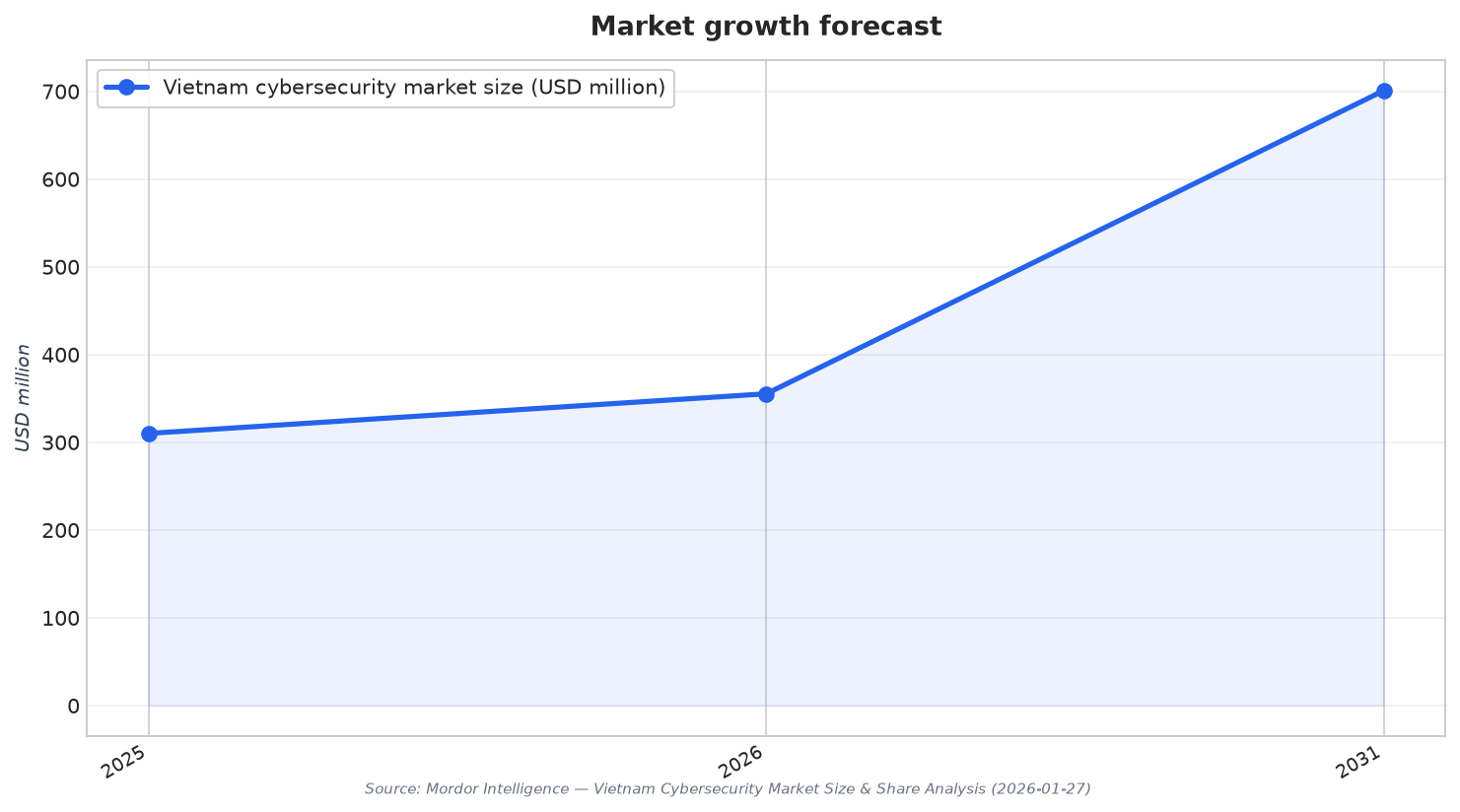
Market structure signals where budgets are already landing. In Mordor Intelligence’s breakdown, solutions held 67.12% of market share in 2025, while services are projected to grow at a 14.86% CAGR to 2031. Cloud is central to this shift: cloud deployments held a 56.02% share in 2025 and are forecast to expand at a 16.92% CAGR through 2031. Organization size also matters. Large enterprises accounted for 60.44% of 2025 share, but SMEs are expected to grow at a 17.62% CAGR to 2031, a pattern consistent with wider cloud migration and expanding connected workflows. End-user demand is led by BFSI at 27.45% revenue share in 2025, while healthcare is identified as the fastest-growing vertical with an 18.75% CAGR through 2031.
How New Data Rules Push Security From Tools to Outcomes
Compliance is also changing what buyers actually purchase. Expert Market Research values Vietnam’s cyber security market at USD 344.09 million in 2025 and projects USD 1,479.13 million by 2035, at a 15.70% CAGR (2026–2035). Its analysis argues that rapid adoption of cloud, mobile banking, e-commerce, digital government services, and connected workplaces widens the attack surface, which makes incident readiness, identity controls, and continuous monitoring more attractive than isolated point products. This aligns with the growing emphasis on managed delivery models such as SOC operations, MDR, and incident response retainers, especially where internal teams are stretched by expanding digital estates and evolving obligations. As a result, “trust” becomes measurable in practice: fast response, local support, and clear compliance alignment are treated as purchasing criteria.
Capacity constraints are becoming a growth lever for service providers. Mordor Intelligence projects a shortage of 700,000 skilled professionals through 2028, which can increase demand for qualified vendors and raise the pricing power of scarce talent. Ken Research separately cites an estimated deficit of 25,000 cybersecurity experts in the upcoming year, highlighting how multiple datasets point to the same operational bottleneck: not enough specialists to implement and run security at scale. Meanwhile, sector-specific opportunities are becoming clearer. NextMSC values Vietnam’s healthcare cybersecurity market at USD 140.69 million in 2025, estimates USD 196.19 million in 2026, and projects USD 1,124.26 million by 2035, with a 21.41% CAGR from 2026 to 2035. It also describes a USD 928.07 million absolute opportunity between 2026 and 2035, reinforcing why regulated data and expanding digital care workflows can attract both platform vendors and niche providers.
Even with strong tailwinds, execution risk remains part of the story. Mordor Intelligence notes fragmented enforcement, SME price sensitivity, and import tariffs on security appliances as factors that can temper the trajectory, even if they do not derail it. At the same time, digitization keeps raising the baseline for security maturity. One public-sector indicator is EVN Southern Power Corporation’s reported shift toward electronic contracts, reaching 5.6 million executed by December 2024, which illustrates how digital processes can scale quickly and require comparable security rigor. Against this backdrop, Vietnam cybersecurity market growth is increasingly shaped by a mix of mandated data stewardship, cloud-first infrastructure choices, and the practical need to outsource monitoring and response when talent is scarce.
What is driving Vietnam’s cybersecurity market expansion under new data rules?
How large is the Vietnam cybersecurity market forecast to be by 2031?
Which segments are growing fastest: cloud, services, or SMEs?
Why are managed security services gaining traction in Vietnam?
What does Vietnam cybersecurity market growth look like in healthcare?