Bac Ninh’s manufacturing profile has sharpened as Vietnam reinforces its role as a key electronics manufacturing hub in Southeast Asia. Vietnam’s electronics industry is described as a pillar of national economic growth in 2026, with export turnover led by phones, computers, and components. Vietnam Briefing states the electronics sector contributed over 35 percent of Vietnam’s total exports last year, reaching a record high of US$165 billion, and that computers, electronics, and components surpassed US$100 billion for the first time. This export engine matters for circuit boards because Nexdigm links strong export performance in smartphones, consumer electronics, and computing devices to rising demand for multilayer and high-density interconnect (HDI) PCBs.
In the north, Bac Ninh sits inside the densest concentration of electronics capacity. Nexdigm notes sustained expansion in provinces such as Bac Ninh, Thai Nguyen, and Hai Phong, where major manufacturers including Samsung Electronics, LG Electronics, Foxconn, and Intel have established large-scale production facilities. The Shiv report adds that the northern region, particularly Bac Ninh and Thai Nguyen, is the primary centre for production and is responsible for nearly half of Samsung’s global smartphone output. Mordor Intelligence also points to consolidation of assembly and test lines around Bac Ninh and Hai Phong to compress lead times, supporting the case that proximity, throughput, and logistics are central to today’s supply-chain decisions.
Why Bac Ninh Became the PCB-and-EMS Gravity Point
Investment scale is a major reason Bac Ninh is treated as a core node for Vietnam PCB electronics manufacturing. Cushman & Wakefield cites the General Statistics Office and says the province led Vietnam in FDI attraction in 2024 with nearly USD 5.12 billion, driven primarily by high-tech and electronics manufacturing. The same source says Samsung, present since 2008, has concentrated nearly 50% of its Vietnam investments in Bac Ninh, including a USD 1.8 billion display and component facility in Yen Phong, contributing to the group’s cumulative USD 23.2 billion investment nationwide by mid-2025. It also says Foxconn has committed approximately USD 3.2 billion, predominantly in Bac Ninh, producing laptops, printed circuit boards, and telecom devices for major brands such as Apple.
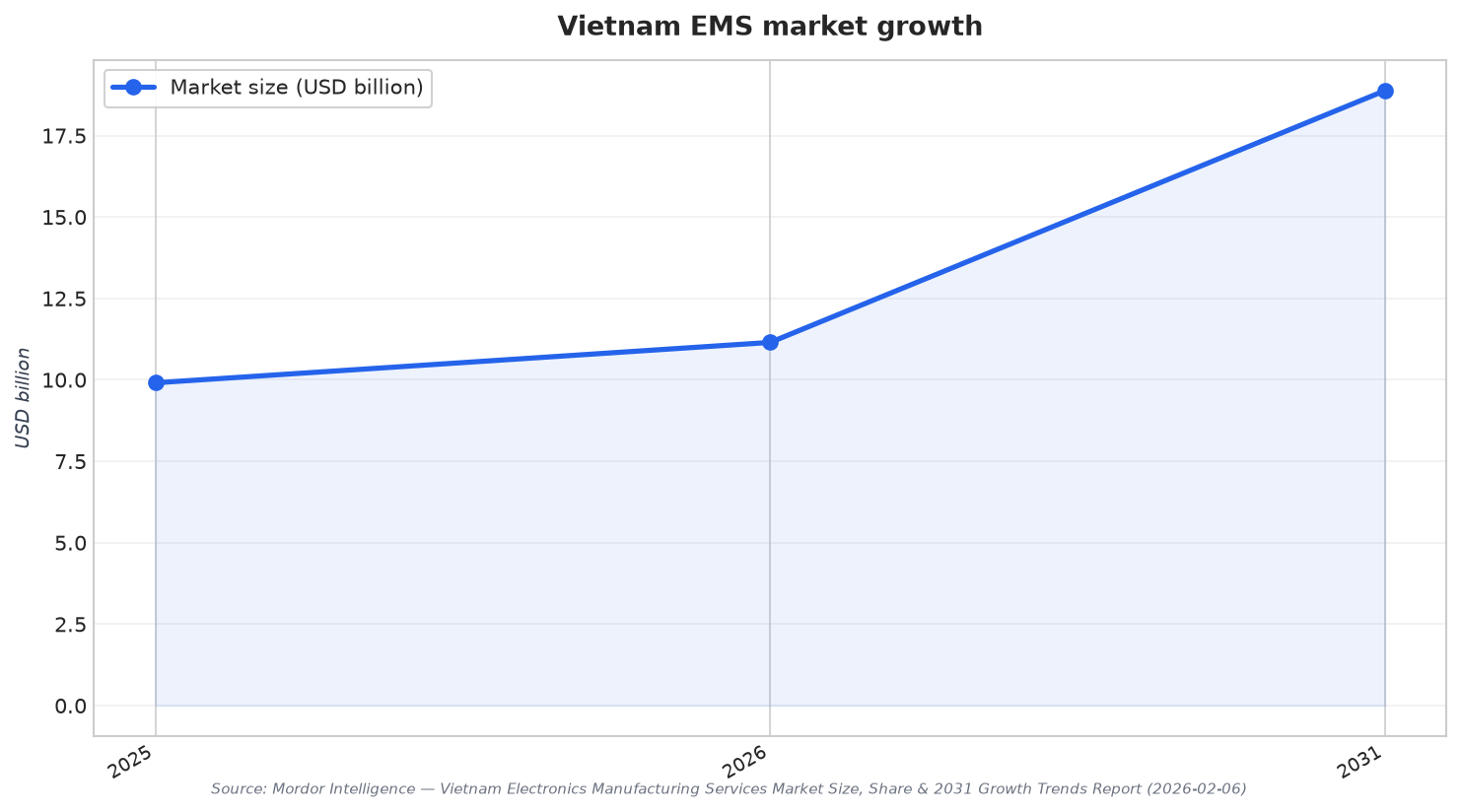
These anchor investments align with how Vietnam’s electronics economy is structured. Vietnam Briefing states FDI firms account for around 98 percent of the country’s electronics exports, reinforcing the connection between electronics manufacturing and foreign investment. It also reports that disbursed FDI rose to a five-year high of US$27.62 billion in 2025, describing a shift toward faster execution of proven projects rather than a rush of new registrations. On the factory floor, Mordor Intelligence estimates Vietnam’s electronics manufacturing services market grows from USD 9.91 billion in 2025 to USD 11.15 billion in 2026, and forecasts USD 18.88 billion by 2031, at an 11.11% CAGR over 2026–2031. In that market, printed circuit board assembly held 43.68% share in 2025, and surface-mount technology accounted for 51.39% in 2025.
Looking beyond boards, Bac Ninh’s role expands into adjacent stages of the electronics stack. Nexdigm highlights that Vietnam still imports a portion of high-end PCB materials and substrates, while domestic assembly and fabrication capabilities are expanding rapidly, supported by FDI and proactive government policies. It also points to trade agreements such as CPTPP and the EU–Vietnam FTA as factors enhancing Vietnam’s attractiveness as an export base. Semiconductor-linked activity is also clustering: Nexdigm’s semiconductor market overview states Ho Chi Minh City, Hanoi, and Bac Ninh have emerged as dominant semiconductor manufacturing clusters due to well-developed electronics infrastructure and access to skilled technical labor, while also listing Bac Ninh among major industrial regions alongside Ho Chi Minh City, Hanoi, and Da Nang. As EMS shifts toward box-build models and demand rises in areas like automotive electronics, Bac Ninh’s integrated ecosystem helps Vietnam move from basic assembly toward higher-value electronics production, where multilayer and HDI PCB requirements increase.
What makes Bac Ninh central to Vietnam’s electronics manufacturing growth?
How important is PCB assembly in Vietnam’s EMS market?
Which northern provinces form the main electronics cluster linked to PCB demand?
How does foreign investment shape Vietnam’s electronics exports?
What does Vietnam PCB electronics manufacturing mean for Bac Ninh’s next phase?