
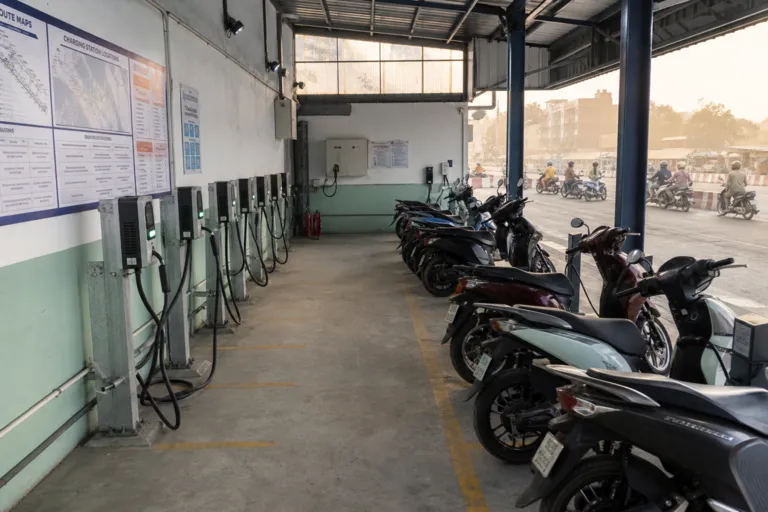
Hanoi’s planned restrictions on petrol motorbikes have turned a policy debate into a real-world deadline. IndexBox, citing the Associated Press, reports that Hanoi plans to ban fossil-fuel motorcycles from its city center in July 2026, while Ho Chi Minh City is weighing a similar step. The scale is enormous. Vietnam has 77 million two-wheelers, including 7 million in Hanoi and 8.5 million in Ho Chi Minh City, and the vehicles are deeply tied to daily commerce and family life. Another report describes how authorities have also “backtracked from an ambitious plan to ban them” in favor of electric two-wheelers, highlighting how hard implementation can be in a city that runs on motorbikes.
Even with political friction, the market signal is already visible. MotorcyclesData says Hanoi’s mid-2026 announcement has “sent a strong signal” and is accelerating electrification. It adds that a “huge increase” in petrol prices reported from March pushed customers toward EVs, and the EV segment “boomed 84.5% so far this year.” IndexBox puts Vietnam’s motorbike market at about 3.5 million units a year and says electric motorbikes account for about 12% of total sales, ranking Vietnam third behind China and India for electrified two-wheeler markets. These numbers frame the Vietnam electric motorbike transition as both policy-driven and price-sensitive.
What the 2026 Timeline Changes for Riders, Fleets, and Brands
Draft boundaries and phased enforcement are central to how Hanoi’s plan could play out. B-Company notes that the first stage of the low-emission zone is expected to focus on central Hanoi, including parts of Hoan Kiem and the Old Quarter. It cites a draft pilot plan starting July 1, 2026 in Hoan Kiem Ward, with a core area of around 0.5 sq.km and a buffer area around the Old Quarter. Muser Press separately reports a previously announced plan to bar petrol motorbikes from a 26-square-kilometre area in Hanoi’s historic centre, illustrating how scope and timing can shift. For riders, this uncertainty sits alongside practical worries about cost, range, and charging convenience.
Industry reactions show both resistance and rapid repositioning. IndexBox reports that Honda and Yamaha say the 2026 timeline is too ambitious. Yet B-Company writes that Honda Vietnam is expanding its electric two-wheeler portfolio with models such as ICON e: and CUV e:, and has tested electric mobility via fleet use, including a delivery project with Vietnam Post to assess range, charging behavior, and maintenance needs. The incumbent base is still huge. VAMM members sold 2.615 million motorbikes in Vietnam in 2025, and in Q1 2026 their sales reached 729,121 units, up 8.3% year-on-year, according to B-Company. Meanwhile, Reuters figures cited by B-Company say VinFast delivered more than 120,000 electric two-wheelers in Q3 2025, up 73% from the previous quarter, after Hanoi’s announcement.
Infrastructure, incentives, and air-quality pressure are the levers that determine whether switching becomes realistic for everyday workers. Mordor Intelligence estimates Vietnam’s e-bike market at USD 70.77 million in 2026, rising from USD 66.54 million in 2025 and reaching USD 96.26 million by 2031 at a 6.36% CAGR over 2026–2031. The same source says 0% vehicle-registration fees stay in force until 2027 and VAT on electric vehicles remains at 8% through 2026, while “pollution red alerts” have hastened plans to make 25% of all registered two-wheelers electric by 2030. It also cites VinFast’s 150,000 public charge points and a planned 30,000–50,000 petrol-station conversions with Vietnam Oil Corporation. Still, IndexBox and B-Company both underline affordability concerns for low-income riders, making after-sales service, charging access, and practical incentives critical to the transition.
When is Hanoi planning to restrict fossil-fuel motorbikes in the city center?
How large is Vietnam’s two-wheeler base in Hanoi and Ho Chi Minh City?
What share of motorbike sales in Vietnam is electric today?
What is happening to EV demand during the Vietnam electric motorbike transition?
What infrastructure and incentives are cited for supporting electric two-wheelers?