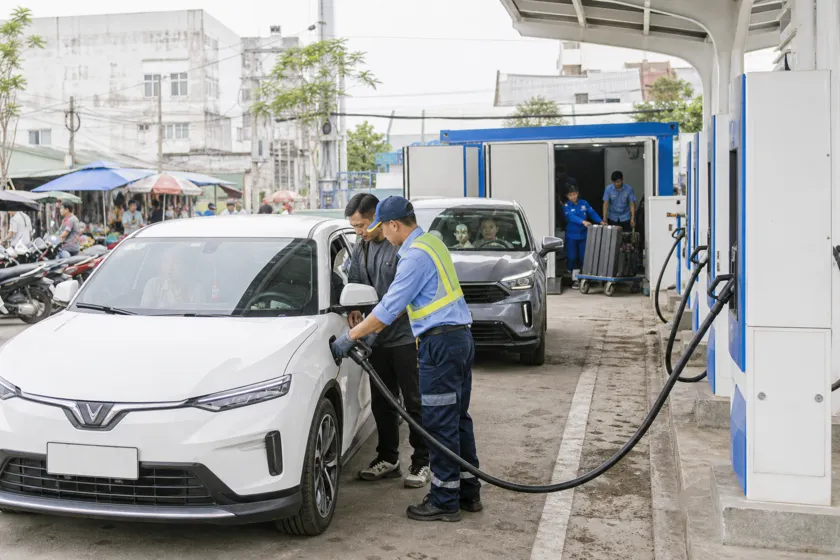
Vietnam’s electric mobility story is no longer just about selling vehicles. It is also about building the backbone that makes daily driving practical. In this race, V-Green stands out as a dedicated charging infrastructure company focused on a smart, convenient, and flexible charging ecosystem. It offers home chargers at 7.4 kW and 11 kW, plus public AC/DC stations ranging from 20 kW to 250 kW, with smart management software and LINK connectivity technology. This approach signals that the market’s next battleground is the experience of charging, uptime, and coverage, not just the showroom pitch.
The scale claims are striking. V-Green’s expansion materials describe successful operations in Vietnam where it manages over 150,000 charging ports through a mix of self-operated and franchised stations. That combination matters because it spreads execution across partners while still keeping a common standard. It also frames the wider Vietnam EV charging infrastructure debate: fast network coverage can come from ownership, from franchising, or from a hybrid that aims to do both at once. In practice, the network becomes an ecosystem asset that can outlast individual model cycles.
From Vietnam to the Region: Coverage, Partnerships, and Proof Points
V-Green is also positioning its playbook beyond Vietnam. It is expanding into high-potential markets in the region, including Laos, Indonesia, and the Philippines. In the Philippines, the company has pursued approvals for EV charging stations in four SM Supermalls, while planning further rollout across Alfamart outlets, educational institutions, and other strategic locations within the BDO–SM ecosystem. It also signed a memorandum of understanding with Meralco, alongside Green GSM, to identify and evaluate sites for EV charging stations and electric taxi hubs.
VinFast’s own plans show how closely vehicle growth is being tied to infrastructure targets. VinFast aims to expand its network to more than 5,000 AC/DC charging points and over 30,000 battery-swapping stations by the end of 2026. In another nationwide push, VinFast announced an ambitious plan to deploy 150,000 battery-swapping stations across Vietnam, starting with 1,000 stations in October 2025, expanding to 50,000 by year-end, and completing the full 150,000-station network within three years. It also offered free charging at all V-Green public stations until June 30, 2027 for cars and May 31, 2027 for scooters.
The takeaway is that charging and swapping are becoming strategic levers, not support functions. VinFast’s Southeast Asia CEO Antonio Zara previously said the company had no immediate plans to establish a manufacturing base in the Philippines, adding it was prioritizing investments in charging infrastructure instead. That priority shows up in local agreements too. V-Green signed a memorandum of understanding with the Provincial Government of Bataan to roll out EV charging infrastructure across the province, including direct-current fast-charging stations and coordination on locations and public awareness. Together, these moves point to a race where the strongest EV brands will increasingly be judged by reliability and access to energy, not only by vehicle specs.
What scale of charging network does V-Green say it operates in Vietnam?
What are VinFast’s charging and swapping targets through 2026?
How fast does VinFast plan to ramp battery-swapping stations in Vietnam?
How is the Vietnam EV charging infrastructure story spilling into the Philippines?
What did VinFast leadership say about priorities in the Philippines?