
Pet humanization is no longer a niche behavior in Vietnam. Owners are increasingly viewing pets as cherished family members, close friends, or even children, and that shift is directly tied to more spending on health, grooming, and lifestyle services designed to improve a pet’s well-being. TGM Research reports that in 2024, 74.5% of Vietnamese households owned at least one pet, up from 67% in 2023. That jump helps explain why brands and service providers are leaning into “pet parent” messaging, premium offerings, and more specialized care routines that mirror how consumers approach human wellness.
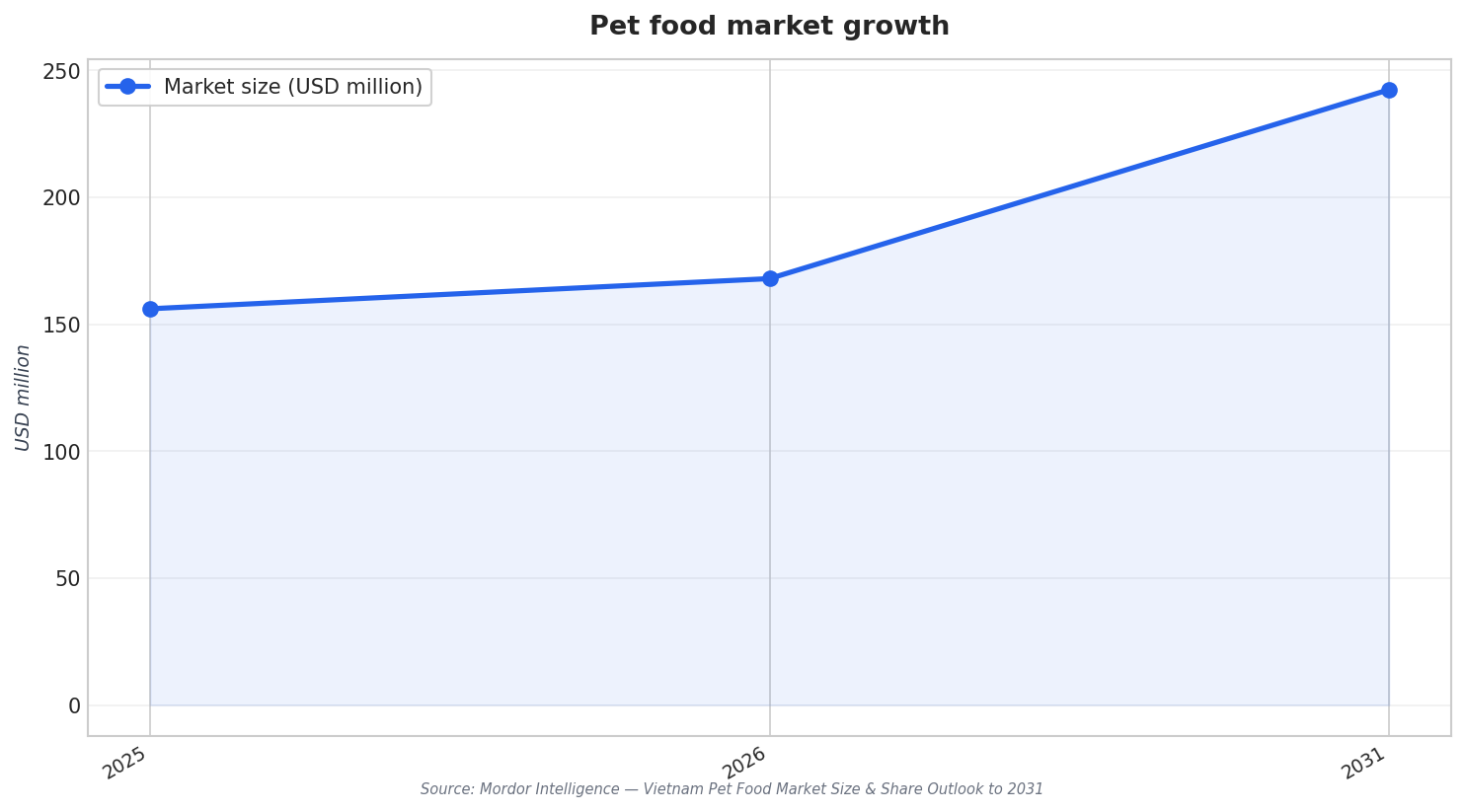
Food remains a central battlefield for premiumization. Mordor Intelligence estimates Vietnam’s pet food market at USD 156.1 million in 2025 and USD 167.98 million in 2026, with projections reaching USD 242.39 million by 2031 (7.61% CAGR over 2026–2031). Ken Research separately values the market at USD 142 million in 2024, with a projection of USD 236.8 million by 2030 (8.9% CAGR across 2025–2030), and also notes historical growth from USD 98.5 million in 2019 to the 2024 base (7.6% CAGR). Together, these outlooks frame a market where trade-up, not just more pets, is a major growth lever.
What’s Powering the Trade-Up: Income, Channels, and “Family-Member” Expectations
Several measurable forces reinforce the trade-up. Mordor Intelligence cites Vietnam’s average monthly income per capita at USD 213 in 2024, a 9.1% increase versus 2023 (compared with a 6.2% increase between 2022 and 2023). The same source says premium segment penetration rose from 15% in 2022 to 23% in 2024, and that Ho Chi Minh City and Hanoi buyers spend 3.2 times more per pet than rural counterparts. On the buying side, specialty stores led distribution with a 72.44% revenue share in 2025, while online is forecast to advance at a 9.33% CAGR through 2031. This is where Vietnam pet care market growth becomes visible in day-to-day behavior: more premium baskets, more repeat purchase, and faster digital discovery.
The product mix is also changing. In Mordor’s breakdown, traditional food held 49.76% share in 2025, while nutraceuticals and supplements are projected to grow at an 11.62% CAGR through 2031. Ken Research adds a structural detail behind the runway: the market is anchored to roughly 12.3 million dogs and cats in 2024, while commercial pet food penetration is about 38%, leaving conversion potential from home-prepared feeding to packaged formats. Mordor’s pet-type split shows dogs at 61.12% of market size in 2025, while cats are forecast to expand at an 8.27% CAGR to 2031, aligning with commentary that premium cat food demand is rising across Southeast Asia, including Vietnam.
Beyond food, services are expanding alongside the humanization mindset. B-Company notes that spa, grooming, and pet hotel services are booming in major cities, shaped by busy owners who still want “the best” care. The same source warns of practical hurdles for market entrants, including import and quarantine procedures: imported pet food is subject to an approximately 7% tax and must go through strict registration and quality control. Capacity constraints are also human: B-Company points to limited highly skilled veterinary and grooming human resources, implying training needs. For brands planning long-term plays, MarkWide Research describes Vietnam as part of an underpenetrated Southeast Asia opportunity, encouraging early moves to build veterinary partnerships before shelf space and relationships consolidate.
What shows pet humanization is becoming mainstream in Vietnam?
How fast is Vietnam’s pet food market projected to expand?
Which channels are leading pet food sales in Vietnam?
What are the biggest obstacles for imported pet food in Vietnam?
What is driving Vietnam pet care market growth in premium products?