
The Vietnam IT outsourcing market is often introduced through cost. Developer rates are cited at US$20–40 per hour versus US$80–150+ in the US, and Mordor Intelligence describes engineers earning roughly one-tenth of global averages. But the more important shift is what buyers now ask for. Vietnam Briefing notes the country is increasingly viewed as a regional hub for cloud services, cybersecurity, platform engineering, and digital consulting. Mordor Intelligence similarly reports demand moving from cost-centric outsourcing toward value-added digital transformation, pushing providers into higher-margin consulting, platform, and managed security work.
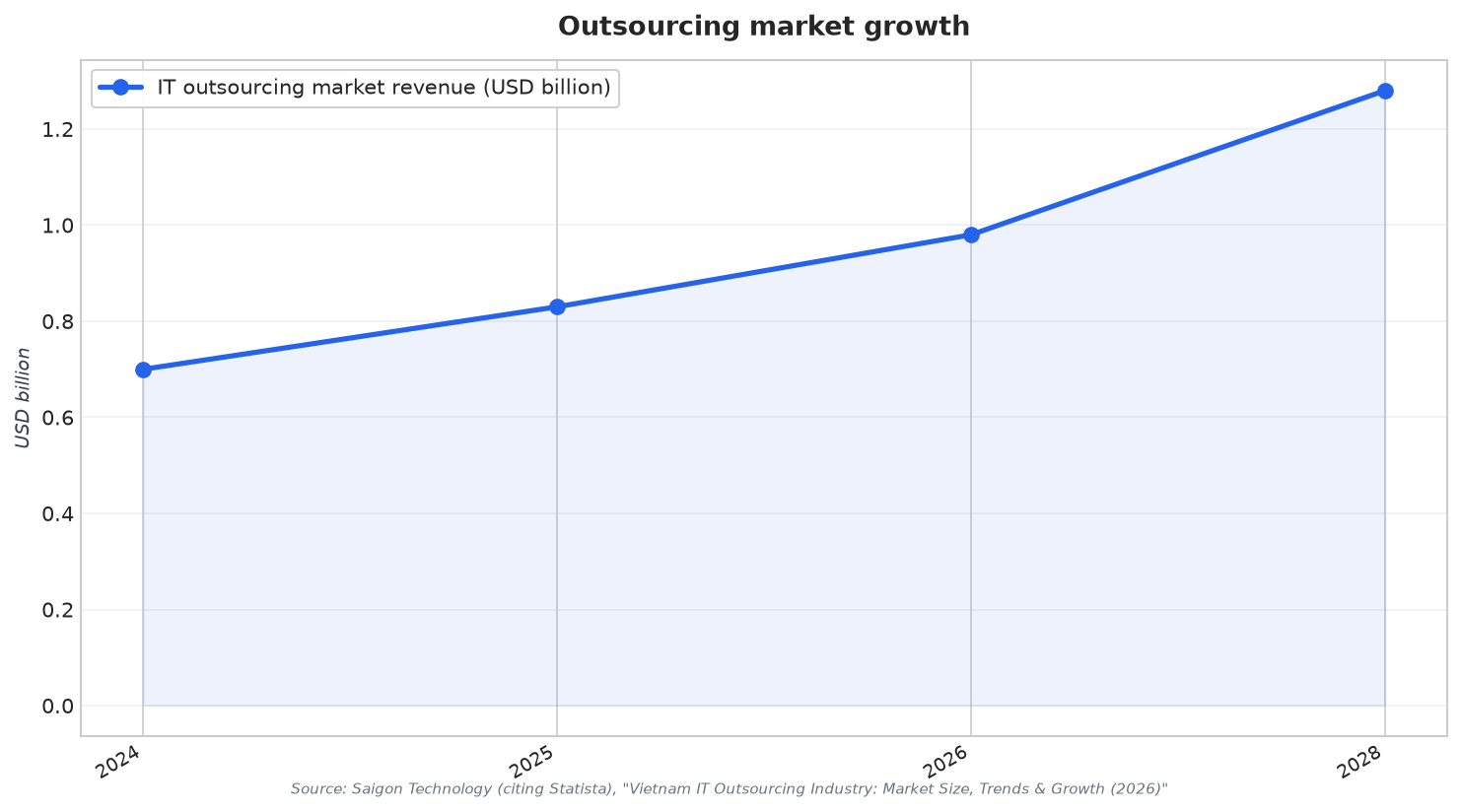
That transition sits on top of a market that is expanding on multiple layers. Statista figures cited by Saigon Technology place the IT services segment at approximately US$0.70 billion in 2024, with projections of US$0.83 billion in 2025 and US$0.98 billion by 2026, and a trajectory toward US$1.28 billion by 2028. On the broader definition, Mordor Intelligence sizes Vietnam’s IT services market at US$2.37 billion in 2025, estimates US$2.63 billion in 2026, and projects US$4.39 billion by 2031 at a 10.82% CAGR (2026–2031). Within that 2025 mix, IT Outsourcing led with 39.05% market share, showing that outsourcing remains central even as the work shifts upward.
What “Moving Up the Value Chain” Looks Like in Practice
Service-mix signals point to where value is accruing. Saigon Technology states software delivery accounts for roughly 40% of the broader IT services market it cites, while Mordor Intelligence forecasts Cloud and Platform Services expanding at an 11.86% CAGR through 2031. Demand is also becoming more specialized by industry and buyer profile. Mordor Intelligence reports that Large Enterprises accounted for 67.72% of Vietnam’s IT services market in 2025, while SMEs are advancing at a 12.74% CAGR to 2031. By vertical, BFSI held a 26.55% revenue share in 2025, and Healthcare and Life Sciences are projected at a 12.15% CAGR through 2031—conditions that typically increase requirements for security, compliance, and managed operations.
Talent scale helps explain why Vietnam can support this climb, even if senior depth is still developing. Saigon Technology estimates between 530,000 and 560,000 software developers, with roughly 55,000–60,000 new tech graduates each year. The government target is 80,000 ICT graduates annually by 2030, including at least 15,000 specializing in AI. The workforce is young, with over 58% of developers under 30 and about 30% mid-level, which can accelerate adoption of modern stacks but also constrains local availability of senior specialists. English proficiency ranks 8th in Asia in the 2024 EF English Proficiency Index, and Japanese and Korean skills are increasingly common, aligning with regional client demand.
Geography and institutions are also shaping higher-value delivery. Saigon Technology describes three main hubs, with Ho Chi Minh City holding about 55% of the IT workforce, Hanoi about 35%, and Da Nang growing as a cost-effective third hub. It also highlights government-backed initiatives in Hanoi, including a US$24 million venture capital fund targeting AI and semiconductors. On the enterprise side, Mordor Intelligence notes foreign multinationals opening delivery centers in Ho Chi Minh City and Hanoi, adding depth to the services ecosystem. Meanwhile, Mordor Intelligence’s ICT coverage reports VNPT launched VNPT Global Solutions on July 10, 2026 to scale software outsourcing and managed cloud services, and flags that talent scarcity can threaten schedules for large cloud-migration and analytics engagements—an operational constraint that matters as Vietnam moves into design- and platform-intensive work.
How large is Vietnam’s IT services market, and how fast is it projected to grow?
How big is the Vietnam IT outsourcing market on a pure outsourcing revenue basis?
Which services show the clearest move up the value chain?
What does the talent pipeline look like for advanced work like AI and cloud?
Where are Vietnam’s main delivery hubs for outsourcing teams?