Vietnam’s pork story is now a scale story. The pig herd rose from 8.8 million in 1976 to 25.5 million in 2023, while pork production grew from 270,000 tons to 4.8 million tons over the same period, an annual growth rate of 6.3%. This long expansion has been paired with structural change: the sector has moved from subsistence and diversified production toward specialized, concentrated, and modern operations. The modernization path includes crossbred and exotic breeds, industrial feed, and modern barn systems, which are becoming defining features of how producers compete.
The most visible change is who produces the pork. Small-scale pig farms fell from 7.8 million in the 1990s—when they held 95% of the pig population—to 2.05 million in 2020, when they kept 50% of the herd and supplied 40% of pork. More recent snapshots tell a similar story: in the last five years, small-scale farming has shrunk by about 5–7% per year, with a deeper 15–20% drop from 2019 to 2022. Today, household farms produce 38% of Vietnam’s pork, while larger farms account for 62%, reflecting a clear consolidation toward industrial and commercial production.
Feed, Biosecurity, and the New Industrial Backbone
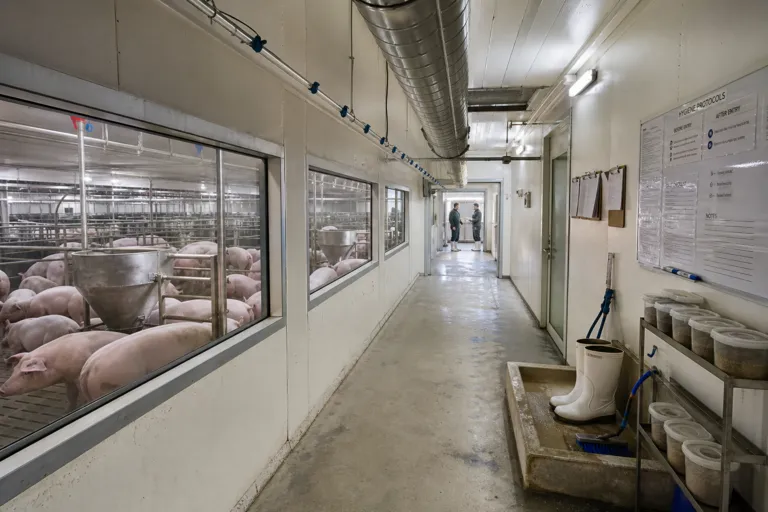
Industrialization requires inputs and risk control that smallholders struggle to match. Vietnam’s livestock output has expanded despite disease and market volatility, as production shifts from small-scale household farms to larger, biosecure, high-tech systems. African Swine Fever (ASF) remains a primary constraint, affecting productivity and farmer confidence, and outbreaks in most provinces have made farmers cautious at times. At the same time, the feed system shows how industrial the value chain has become: the pork segment consumes about 11 million tons of industrial feed annually, and the livestock feed industry is heavily import-dependent, sourcing over 65% of raw materials and over 90% of feed additives from abroad.
Modernization is also becoming geographic and logistical. The South is described as the most operationally important supply cluster, led by the Dong Nai and Ho Chi Minh City corridor. In the first ten months of 2024, Dong Nai supplied more than 601,200 tonnes of meat and maintained a pig herd of over 2 million heads, giving processors and distributors a dense corridor for aggregation. Nationally, Vietnam’s average meat consumption is about 65–68 kg per person per year, supporting high daily throughput across wet markets, foodservice, and formal retail. In this environment, suppliers with reliable livestock sourcing, cold-chain logistics, and consistent slaughter economics can gain scale advantages beyond spot trading.
These shifts are reshaping how value is captured in the vietnam livestock pork industry and the broader meat economy. Vietnam’s meat products market stood at USD 7,450 Mn in 2024 after an estimated 4.4% CAGR during 2019–2024, and it is projected to reach USD 10,120 Mn by 2030, with value growth expected at a 5.2% CAGR during 2025–2030. Volumes are projected to rise from 5,850,000 tonnes in 2024 to about 7,360,000 tonnes by 2030. The market outlook emphasizes a gradual shift from volume-led fresh meat toward higher-value chilled, processed, and branded offerings, which tends to favor integrated players that can deliver food safety, convenience, and traceability at scale.
How has Vietnam’s pig herd and pork output changed over time?
How fast are small-scale pig farms shrinking in Vietnam?
What share of pork comes from household farms versus larger farms today?
Why is feed a key bottleneck for industrial pork farming?
What is changing in the Vietnam livestock pork industry as the meat market grows?