

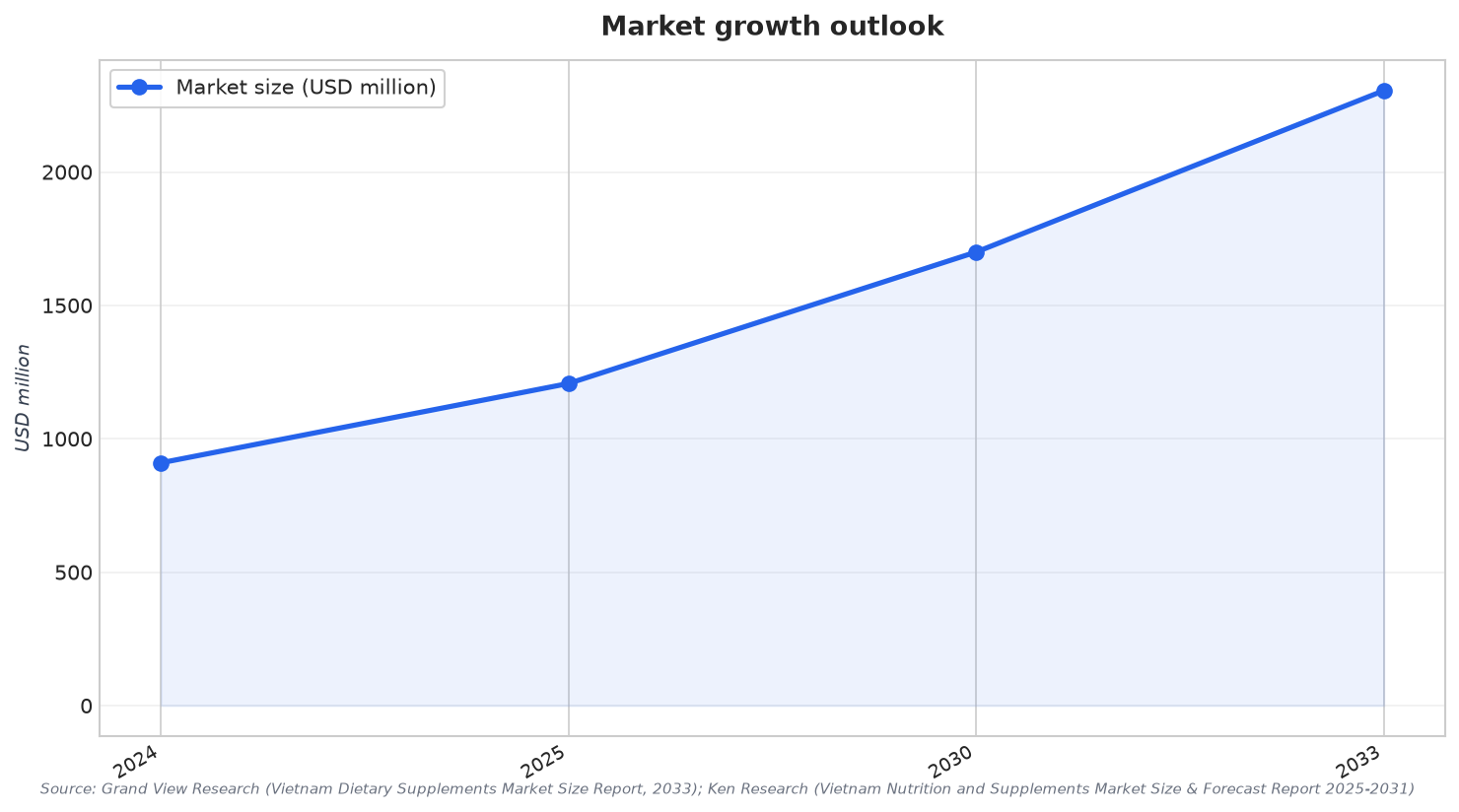
The Vietnam dietary supplement market is scaling quickly, and the stakes are rising with it. One market estimate put Vietnam’s dietary supplements at USD 1,207.3 million in 2025, with a projection of USD 2,304.9 million by 2033 at a CAGR of 8.3% for 2026 to 2033. Another databook also evaluated 2025 at USD 1,207.33 million and expected growth to about USD 2,704.70 million by 2035 at a CAGR of 8.40%. On the ground, demand has been linked to rising health awareness and a preference for certified, trusted brands. Vietnam’s population exceeds 100 million, including more than 9 million people aged 65 and above, a demographic backdrop that keeps preventive wellness in focus.
At the same time, confidence has been shaken by public scandals tied to nutritional products. NutraIngredients reported that the discovery of an illegal milk production ring, counterfeit health supplements, and false advertising sparked widespread concern about products sold in Vietnam. That concern matters because growth is not only about demand, but also about whether buyers believe labels and claims. In that same report, Vietnam was described as the second-largest importer of Australia’s health supplements, behind China. Euromonitor figures cited there valued Vietnam’s health supplements market at US$2.9 billion last year and forecast it would reach US$4.6 billion by 2030, framing both the opportunity and the risk when counterfeit goods enter fast-growing channels.
Regulation and Standards: From Crackdown to Rebuild
Authorities and industry groups are signaling that the response will be structural, not cosmetic. After the scandal broke, Vietnam’s Prime Minister Pham Minh Chinh ordered a review of food safety regulations, and manufacturers were told to expect more surprise inspections and a tighter product registration process. The Vietnam Association of Functional Foods (VAFF) described 2025 as a period of serious upheaval and pointed to incomplete institutional frameworks, while also expressing hope that new laws and decrees would help the industry recover. Regulatory consultants also highlighted that Vietnam was reviewing decree no. 15/2018/ND-CP, and proposals included adding stability test findings into the registration process, which was not required at that point.
Within the product mix, the market’s leading segments help explain why quality control and authenticity matter. In 2025, botanical supplements held the largest revenue share at 48.6% in one estimate, while tablets led by form with a 29.6% revenue share. Adults represented the largest end-use group at 67.2% of revenue in 2025. A separate Vietnam health supplement report described dietary supplements as the largest product segment with over 45% share, and noted vitamins and minerals at around 40% share, followed by botanicals at 28%. These category splits underline why clearer standards, stronger claims oversight, and better verification in pharmacies and e-commerce can materially influence what consumers choose.
Distribution realities also shape how trust is earned. Ken Research described fragmented channels across pharmacies, marketplaces, supermarkets, and direct-selling networks, which can complicate pricing and strain distributor confidence when online promotions spill into offline trade. In that environment, compliance capability was described as a commercial moat, because larger operators can absorb testing and registration costs while smaller informal brands struggle. Counterfeit risk is also tied to unverified online purchases, as noted in a market update that flagged counterfeit concerns when consumers buy unverified supplements online. The clean-up, then, is not only enforcement. It is also about making regulated channels, transparent registrations, and credible labeling the easy default for shoppers.
How large is the Vietnam dietary supplement market, and how fast is it projected to grow?
What triggered the recent trust issues around supplements in Vietnam?
What regulatory changes are being discussed to reduce counterfeits and improve quality?
Which supplement segments lead the market by ingredient, form, and end use?