
Vietnam’s mental health market spans psychiatric consultations, psychological counselling, inpatient treatment, rehabilitation, medication management, school support, workplace programs, and digital services. One estimate in the market summary puts the share of residents experiencing one of ten common mental disorders at 14.2%, implying a potential affected population exceeding 14 million. Commercial outcomes depend on diagnosis, treatment conversion, session frequency, medication adherence, and continuity of care—levers that reward providers who can structure pathways rather than offer one-off sessions.
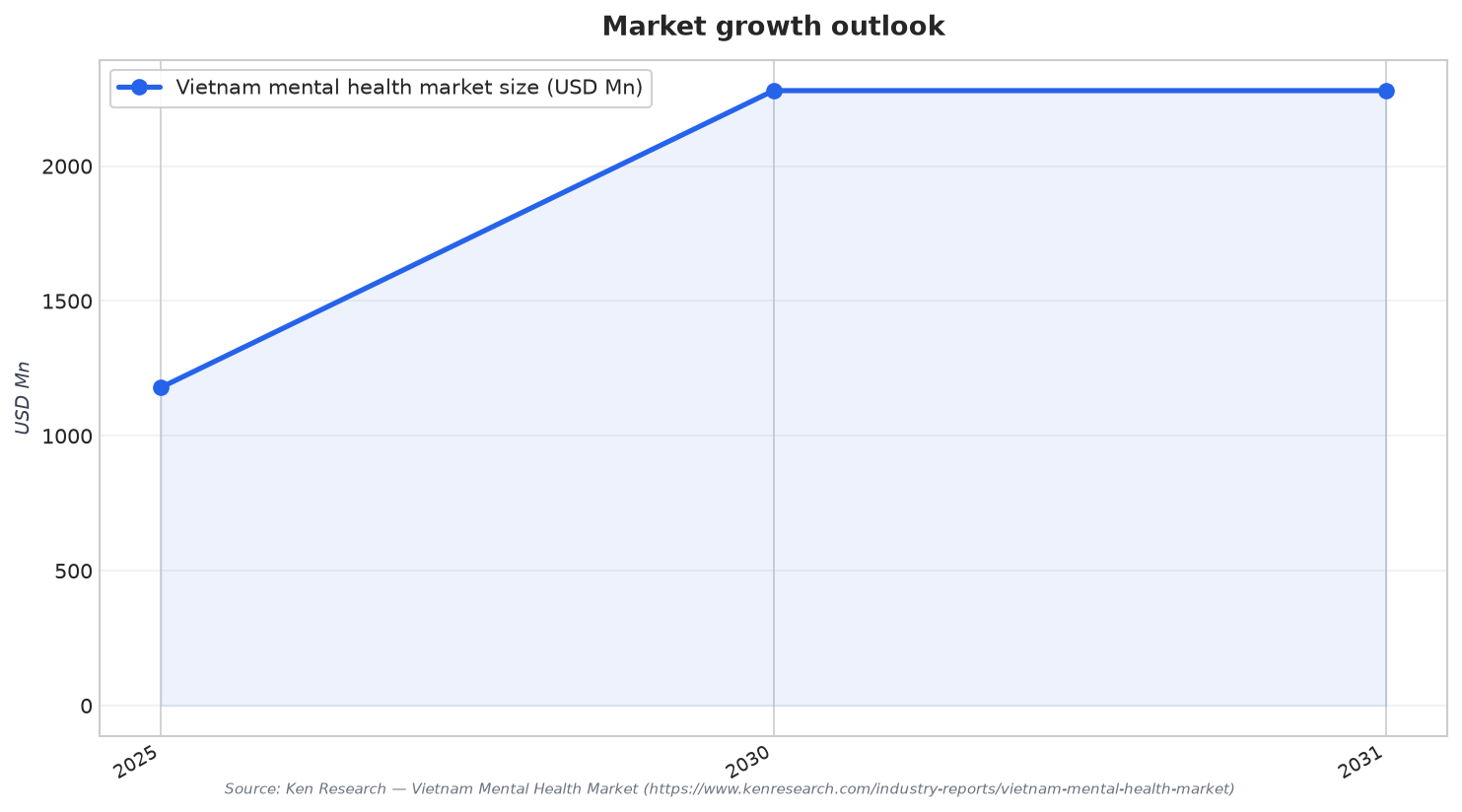
The topline investment story is already visible in market value and growth forecasts. One report values the Vietnam mental health market at USD 1,180 Mn in 2025 and projects expansion to USD 2,280 Mn by 2031, implying an 11.6% forecast CAGR for 2026–2031. That pace is described as higher than the 9.3% historical CAGR recorded during 2020–2025. The report also notes Southeast Vietnam as the dominant region in 2025 and identifies technology as the fastest-growing segment, setting up a race to combine clinical credibility with scalable delivery models.
Where the Gap Is Biggest: Workforce Concentration and Provincial Undersupply
Market demand is not the only issue; capacity distribution is a structural constraint and an opportunity. Service capacity is concentrated in Hanoi, Ho Chi Minh City, Bien Hoa, and Da Nang, with approximately 65.7% of the psychiatric workforce located in these four urban centers. At the same time, 37 of 63 provincial health systems are reported to have neither psychologists nor psychotherapists in public facilities. This imbalance can strengthen private-provider economics in major cities, but it also signals a large, underserved provincial market where digital triage, referral management, and hybrid clinician-led care could reduce geographic friction if quality and escalation standards are designed in from the start.
Policy and public planning point toward broader integration rather than isolated specialty care. A psychiatry clinic market report notes that in 2023 Vietnam implemented a Mental Health Law that aims to enhance services, including establishing mental health facilities in all provinces and integrating mental healthcare into primary health services. Separately, a global market source describes Vietnam’s 2024–2030 plan to train 5,000 commune health workers and fund 30 district psychiatric wards. Together, these moves can expand entry points for screening and referral, increasing the addressable pool for outpatient therapy, telepsychiatry, and coordinated follow-up.
Employers are also becoming a major channel for earlier intervention. A workplace stress management report values that segment at USD 8 million and links growth to rising awareness, corporate wellness programs, and digital tools such as mindfulness apps and virtual counseling. It also cites the Law on Mental Health, 2023 requiring organizations to implement workplace mental health promotion measures, including stress assessment for employees exceeding 50 in number and provision of counseling services. In adjacent benefits spending, a corporate wellness and digital health report values that market at approximately USD 1.2 billion and projects telehealth usage to increase by an estimated 32% in the future, creating room for integrated employee pathways rather than isolated workshops.
How large is the Vietnam mental health market, and how fast is it projected to grow?
What evidence shows unmet need outside major cities?
Which parts of the market are positioned to scale through technology?
How is government action shaping future demand and access?
Why are employers a meaningful channel for Vietnam mental health services growth?