Talk about Vietnam and dentistry, and cosmetic tourism often dominates the conversation. But the more durable story is the depth of local demand and the scale of the provider base serving Vietnamese patients every day. A 2026 competition analysis estimates 5,500+ dental clinics across Ho Chi Minh City, Hanoi, and Da Nang alone, and says roughly 95% of practices serve the domestic market exclusively. This is not a niche ecosystem built only for foreigners. It is a broad services network responding to rising patient expectations, more routine visits, and a market that keeps professionalising city by city.
Multiple sources also point to strong growth in the underlying services economy. The same 2026 analysis estimates Vietnam’s dental services market at about USD $1.5–2 billion in 2025, with projected growth at a 12–15% CAGR through 2030, driven by both domestic demand and dental tourism. It links the domestic pull to rising incomes and coverage: Vietnam’s GDP per capita is described as having tripled since 2010 to about $4,300 in 2025, and government health insurance is said to cover basic dental care for over 90% of the population. Together, these shifts make check-ups and basic treatment more normal, while also feeding referrals toward private clinics for more complex work.
A Two-speed Clinic Landscape: Local Volume vs International Standards
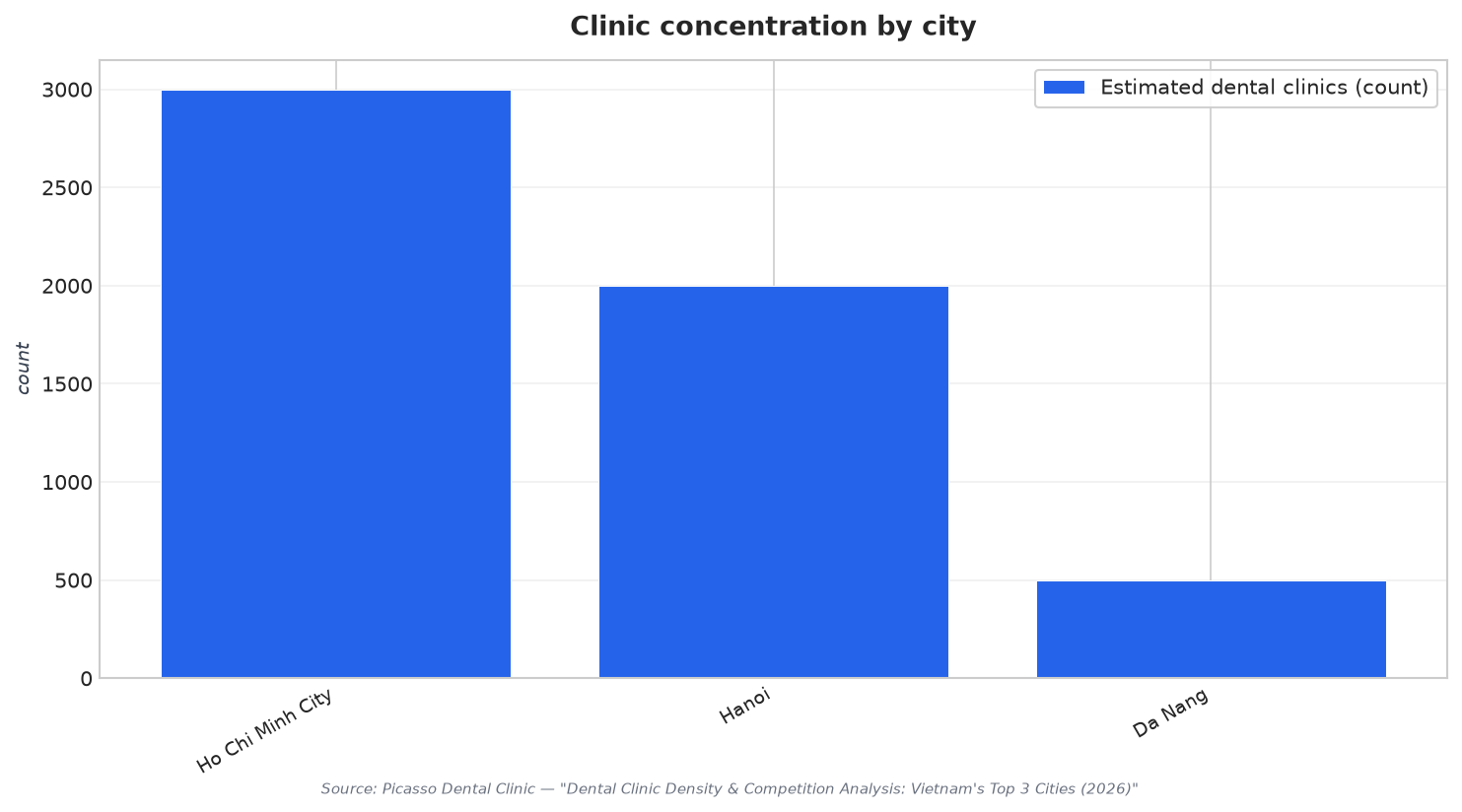
The provider landscape shows why domestic momentum matters. Ho Chi Minh City is estimated to have 3,000+ clinics, Hanoi about 2,000+, and Da Nang about 500+, with many operating as small practices with 1–3 dental chairs. Yet that same report estimates only 50–100 clinics nationwide operate at international standards targeting foreign patients. That split is crucial. It suggests that while inbound tourism can be high value, the system’s main engine is still local utilisation across thousands of practices. It also explains why competitive pressure is intense in big cities, pushing clinics to upgrade workflows, staffing, and technology to stand out with Vietnamese patients as well as visitors.
Dental tourism remains an accelerator, but it is not the whole market. One Vietnam-focused tourism market report estimates Vietnam’s dental tourism sector at $200–500 million in 2025 and projects 15–25% CAGR, with a base-case of $1.8–2.5 billion by 2034. A separate timeline report describes the shift from near-zero international dental patient volumes before 2015 to “tens of thousands” of dental tourists annually by 2026, supported by e-visa expansion to all nationalities in 2023 and 45-day visa-free stays for 13 countries, plus direct flights from 40+ international cities. These flows help clinics invest in capabilities that also benefit locals, including CBCT, CAD/CAM, and digital implant planning systems.
Put together, the vietnam dental care market is booming because it has two reinforcing demand streams. Domestic demand is broad-based, supported by basic dental coverage for over 90% of the population and a large clinic footprint concentrated in three metro areas. Meanwhile, international demand adds margin and urgency to modernise. External comparisons highlight the cost gap pulling visitors in: one report states procedures in Vietnam cost 60–80% less than in Australia, the US, the UK, and New Zealand, and gives an example where a full-arch implant restoration priced at $25,000–$40,000 in Australia is $8,000–$12,000 in Vietnam. The result is a market where domestic volume and international competitiveness rise together.
What is driving domestic growth in Vietnam’s dental sector?
How large is Vietnam’s dental services market according to the sources?
How concentrated is the clinic network in Vietnam’s biggest cities?
How many clinics in Vietnam target foreign patients at international standards?
Why is the Vietnam dental care market rising beyond cosmetic tourism?