
Vietnam is moving to a new land valuation approach that is intended to be closer to market reality. Under the Land Law 2024, Vietnam shifted from a government-set pricing framework to market-based land valuations starting January 1, 2026. Provinces and cities now issue annual land price lists that are supposed to reflect actual transaction prices. In practice, many provinces and cities are preparing land price tables with significantly higher rates, reflecting an effort to align with actual market prices, according to economist Nguyen Quang Huy. This is the practical turning point in the Vietnam land price framework debate, because the table becomes the anchor for costs that ripple through projects, leases, and end-user pricing.
The economic transmission mechanism is straightforward. When land price tables are developed to closely reflect market developments, land use fees and land lease fees rise, and housing prices can continue to escalate, especially if the “market price” is shaped by speculation or irrational auctions rather than fundamentals. A Vietnam.vn analysis warns that in a market with insufficient transparency in planning and transactions, the assumption that market prices accurately reflect land value does not always hold. It also argues that as price tables follow short-term fluctuations, the State’s room to proactively regulate land prices narrows. This shifts real estate economics from long-term planning to continuous repricing of land inputs.
How Market-Based Tables Reshape Business Models
For operating businesses, the change is no longer just a property-market story. At a meeting between the Prime Minister and the business community, Dang Hong Anh of the Vietnam Young Entrepreneurs Association said some firms saw land lease fees rise from approximately 600 million VND in the 2016–2020 period to 20.8 billion VND in the 2026–2030 period, about 35 times higher than the initial lease contract price. In 2025 alone, land lease fees accounted for up to 50% of net revenue for some businesses. These figures illustrate how land can shift from being an input to production into a financial asset, with higher rents and stronger incentives to hold land for price gains.
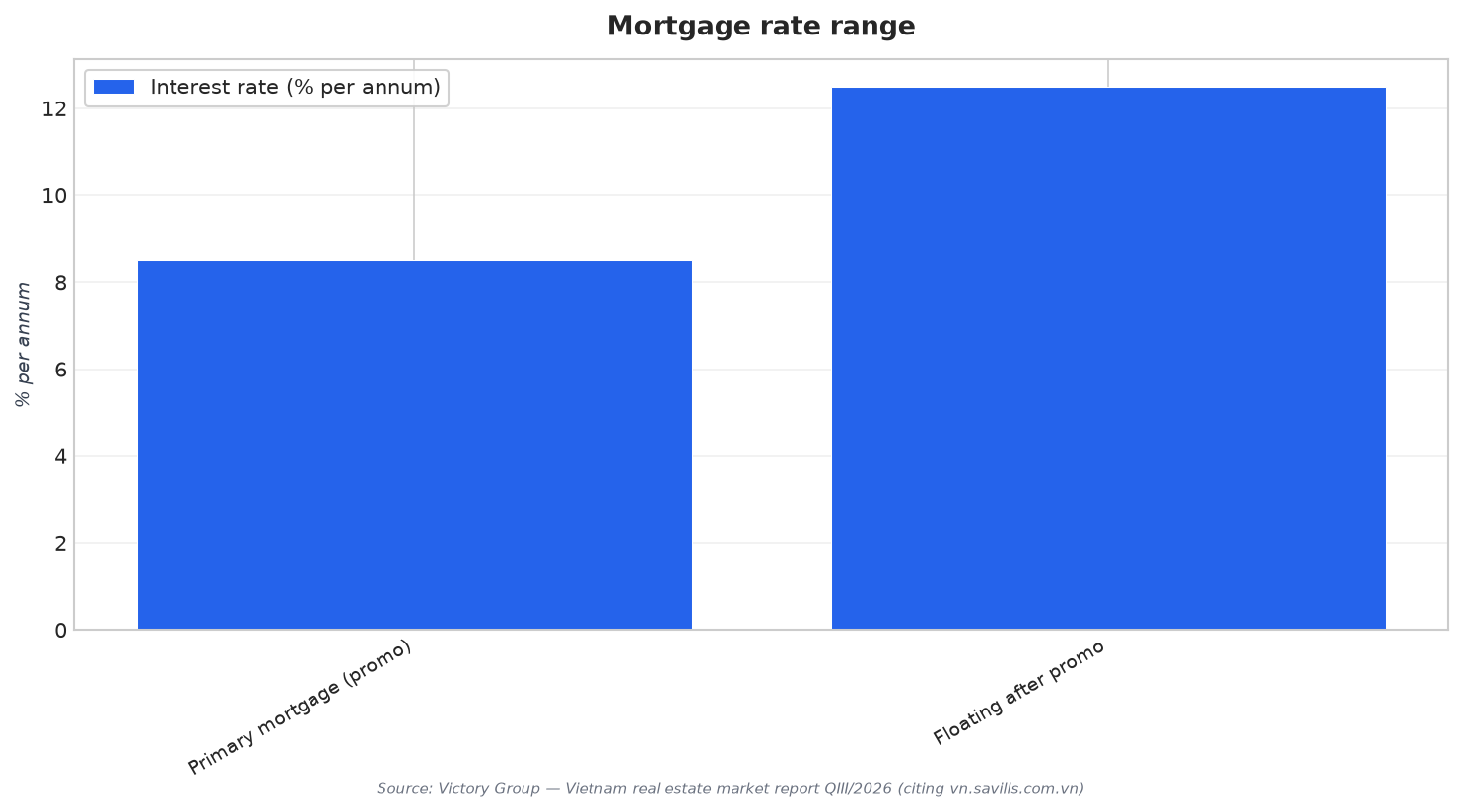
For residential developers and buyers, higher land inputs collide with financing realities. Victory Group cites primary home mortgage rates during promotional periods at approximately 6.5%–8.5% per annum for the first 1–2 years, with floating rates after that at approximately 10.5%–12.5% per annum, described as a psychological barrier for leveraged buyers. At the same time, Mordor Intelligence estimates Vietnam’s residential real estate market size at USD 34.12 billion in 2026 and projects USD 58.93 billion by 2031, while noting apartments and condominiums led with 70% market share in 2025. In fast-moving submarkets, OwnPropertyAbroad reports real estate prices in Da Nang rose roughly 25% year-on-year in Q3 2025 and that primary apartment prices now average around VND 77 million per sqm for new projects in good locations.
Policy design and data quality will decide whether annual tables stabilize or amplify cycles. VietNamNet reports the key challenge is ensuring new prices are market-based without triggering a financial shock to households, businesses, or the broader property sector. Nguyen Quang Huy argues land price tables should be based on real transaction data, digital valuation maps, and objective evaluation methods. Resolution 18 calls to abolish the land price framework and establish mechanisms for determining land prices based on market principles, and that spirit is institutionalized through tables meant to reflect market prices. The difficult part is making “market-based” mean verified transactions, not speculative noise, so costs align with real economic value.
What changes in Vietnam’s land valuation approach from 2026?
Why can market-linked land price tables push up housing and business costs?
How big can the impact be on land lease fees for businesses?
How do borrowing costs interact with higher land costs in the property market?
What does the Vietnam land price framework discussion say about how to set tables fairly?