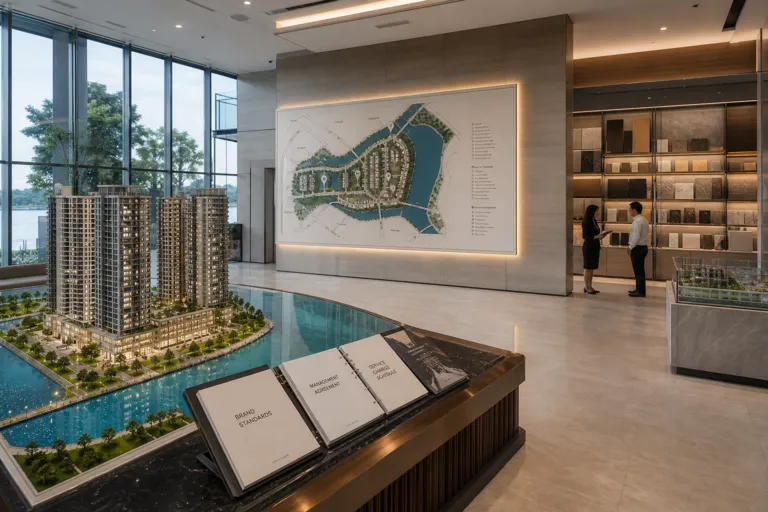
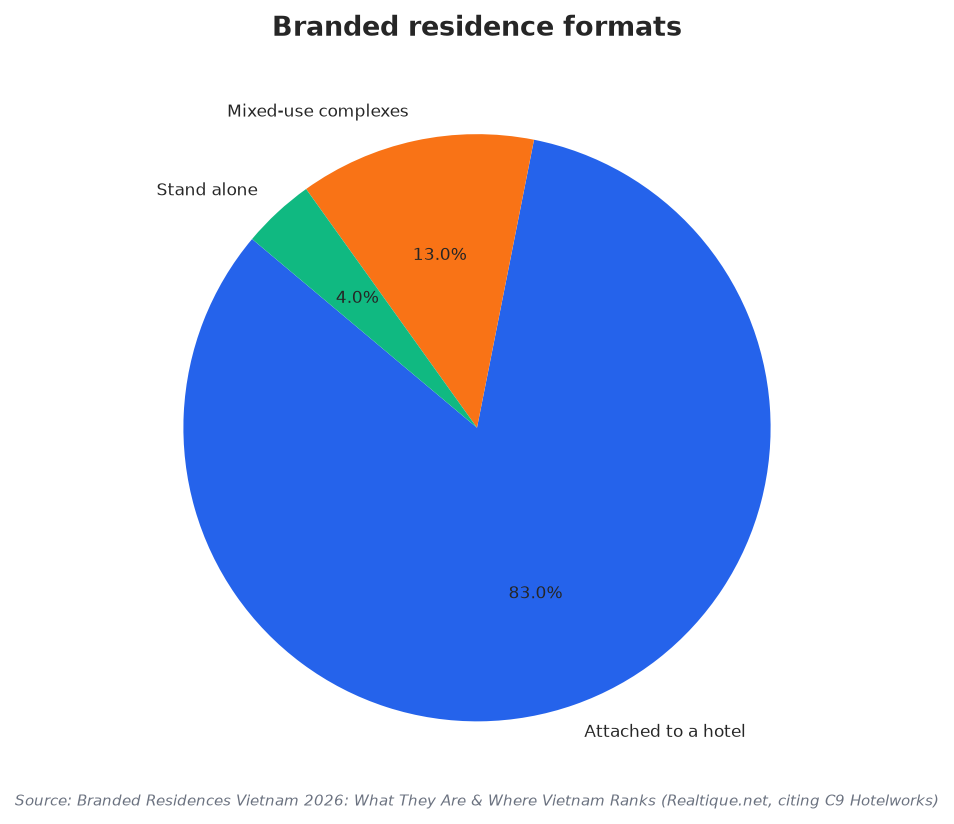
Luxury with a logo is no longer a niche story in Vietnam. It is becoming a structured product category that sits at the intersection of hospitality operations and high-end homeownership. A branded residence is a home that carries the name of a hotel or lifestyle brand, where the brand supports design standards and typically runs services to hotel expectations. In Vietnam, most projects of this kind sit alongside a hotel of the same brand. C9 Hotelworks’ breakdown says 83% of branded-residence projects in Vietnam are attached to a hotel, 13% are in mixed-use complexes, and 4% stand alone. For buyers, that operating model matters as much as the floor plan.
The scale and momentum are visible in the headline rankings, even if the reports measure slightly different things. VnExpress reported that Savills ranks Vietnam fourth globally in the number of branded residences, behind the U.S., Saudi Arabia, and Mexico. A separate Global Branded Residences (GBR) ranking, also reported via VnExpress, places Vietnam third worldwide by units, counting 16,135 branded units across 68 projects (completed and in development), behind the UAE with 84,972 units and the United States with 71,592 units. That same GBR snapshot notes that more than 70% of Vietnam’s projects, 49 of 68, are not yet complete, which means pipeline risk and delivery quality are central to any premium pricing thesis.
A High-End Playbook: Verify the Brand, Track the Pipeline, Follow the Luxury Shift
A smart playbook starts with confirming whether a project is “genuinely branded” rather than simply marketed with a borrowed name. Realtique highlights three signals: a formal brand agreement between developer and hotel group with a fixed term and termination conditions; the brand runs or supervises operations instead of only lending a logo; and the residence is usually co-located with a hotel of the same brand. Next, track where supply is actually building. C9 Hotelworks’ Asia Branded Residences Market Review 2026 says Vietnam leads Asia’s branded residence sector by value within a USD 40 billion regional market, and it estimates Vietnam has 15,762 units (launched and unlaunched) across 47 projects. It also notes that Thailand has 13,124 launched units, compared with 12,592 launched units in Vietnam, showing how pipeline definitions can change league tables.
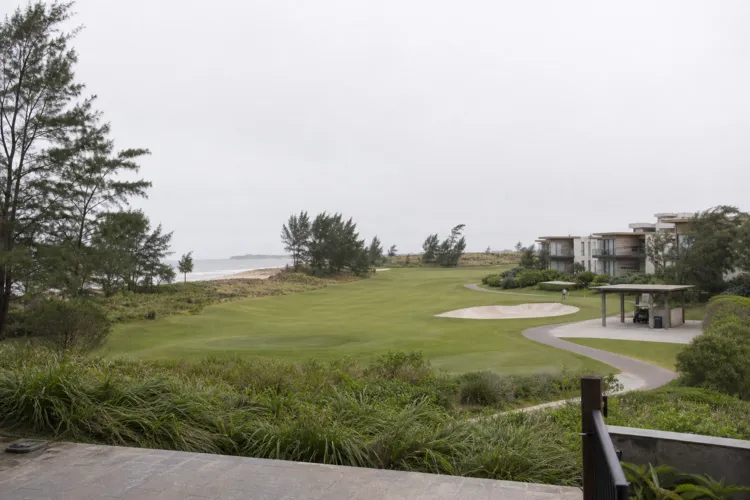
Location strategy is also being rewritten by tourism and a broader luxury push. Leading Hoteliers reports about 12.3 million international visitors in the first half of 2026, up 14.9% year-on-year, with a national target of 25 million foreign arrivals for the full year. In the same report, Vietnam’s branded-residence market is described as reaching about USD 8 billion, accounting for 20% of Asia’s total branded-residence value, with more than 50 projects and 34 international brands. The development map is split too: Ho Chi Minh City faces a tight luxury pipeline, while coastal destinations such as Da Nang and Phu Quoc absorb nearly 30% of upcoming national room construction. That coastal intensity can support lifestyle demand, but it also raises competitive pressure when multiple luxury schemes launch at once.
Finally, treat luxury residences as part of a wider capital stack that includes sales, rentals, and brand-led operations. Mordor Intelligence values Vietnam’s luxury residential real estate market at USD 3.02 billion in 2025, estimating growth from USD 3.42 billion in 2026 to USD 6.36 billion by 2031, at a 13.22% CAGR during 2026–2031. It also finds apartments held 70.35% market share in 2025, with Ho Chi Minh City at 37.65% share by city. Yet branded supply is spreading beyond the traditional coastal base: Vietnam News notes expansion into large urban centres such as Ho Chi Minh City and Hanoi, while C9 Hotelworks finds Vietnam accounts for about 41% of branded residences under development across the region, the highest share in Asia. For investors looking at vietnam branded residences, the advantage is the operational promise; the discipline is verifying who delivers it, and on what contractual terms.
What defines a genuine branded residence in Vietnam?
How does Vietnam rank globally for branded residences, and why do rankings differ?
What do the latest figures say about the pipeline of Vietnam-branded residences?
Where is supply clustering: cities or coastal destinations?
How large is Vietnam’s luxury residential market in this period?