
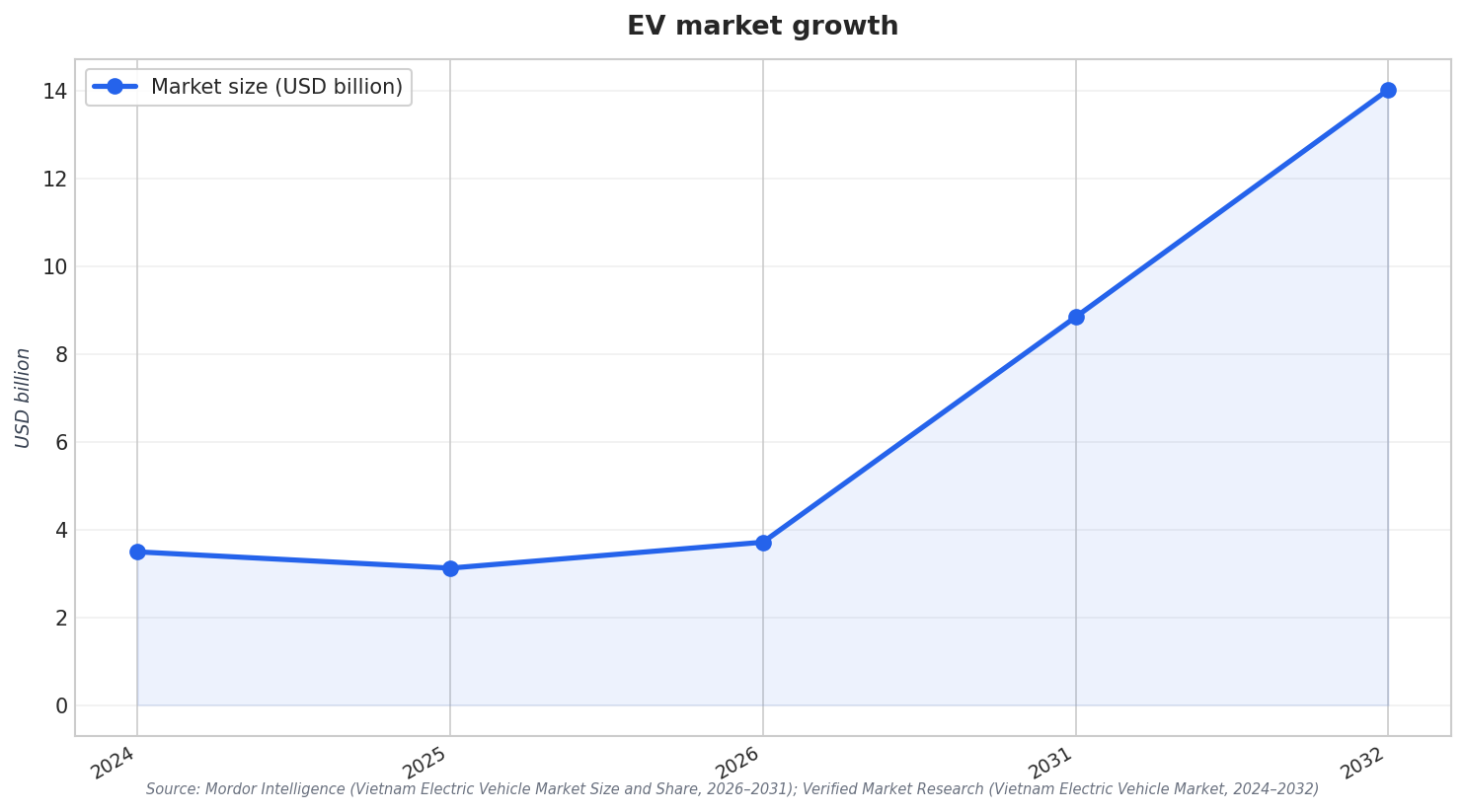
Vietnam’s EV growth story is increasingly tied to where drivers can charge, not just what they can buy. Market forecasts underline the pace: Mordor Intelligence estimates Vietnam’s EV market at USD 3.12 billion in 2025 and USD 3.71 billion in 2026, projecting USD 8.84 billion by 2031 at an 18.95% CAGR (2026–2031). Verified Market Research values the market at USD 3.49 billion in 2024 and projects USD 14.02 billion by 2032, with a 19% CAGR (2026–2032). Those trajectories raise a practical question: can charging availability keep up as adoption spreads beyond Hanoi and Ho Chi Minh City, which Verified Market Research describes as primary hubs for EV sales and infrastructure investment?
Policy direction is clear, and it has implications for charging coverage outside the core urban grid. Sources cite government targets mandating 50% EV penetration in urban areas by 2030 and net-zero emissions by 2050. Bolt.Earth also points to a longer-run policy arc: it describes a decision emphasizing EV production, import, and charging infrastructure from 2022 to 2030, followed by phasing out fossil-fueled vehicles by 2040 and ensuring all road vehicles run on electric and green energy by 2050, supported by a nationwide charging infrastructure. That framing matters for provinces, too. Bolt.Earth notes Article 33 of Decree 10/2020/ND-CP mandates provinces and central-level cities to create development and management plans for road vehicles, which can shape where chargers appear beyond city centers.
From City Networks to Provincial Coverage: What’s Changing
Vietnam’s charging buildout is heavily influenced by an integrated OEM ecosystem, and that has helped reduce barriers like range anxiety and service access. MarqStats describes VinFast’s strategy as spanning charging (V-Green), ride-hailing (Green SM / GSM), bus services (VinBus), and more, creating a “self-reinforcing adoption loop.” It also cites major rollout figures: 150,000+ charging ports and 400 service workshops, plus a planned 99 ultra-fast hubs in 2026 and free charging until 2027. In parallel, the same report highlights demand-side supports, including a 0% registration fee (Decree 51/2025 through February 2027) and a 3% special consumption tax for BEVs, which MarqStats says reduces total cost of ownership by 15–25% versus equivalent ICE vehicles.
Closing the gap outside city centers is not only about more plugs; it is also about the right placement and standards that unlock investment. Nexdigm emphasizes that “a charger near home or workplace carries more weight than dozens scattered across a city,” while noting coverage remains uneven outside major urban zones. Bolt.Earth flags gaps in EV-related technical standards and argues that standardizing technical regulations for EVs, charging infrastructure, and vehicle disposal can instill investor confidence across the value chain. It also notes activity beyond passenger cars: 21 provinces have piloted electric three-wheelers for waste collection and electric four-wheelers for tourism, suggesting use cases that can justify chargers in smaller localities. Together, these signals show why the vietnam ev charging infrastructure conversation is shifting from showcase urban corridors to everyday, distributed access.
The next phase depends on how resilient the buildout is once incentives face renewal risk, and whether charging economics hold as demand broadens. MarqStats highlights uncertainty about whether incentives extend beyond February 2027. In the same vein, the GIIResearch summary mentions “continuity beyond 2027” and ties it to reaching cost parity, noting a fiscal-policy rollover risk. It also cites preferential charging tariffs of 2,204 VND/kWh as a factor that tilts total cost of ownership toward electric models. Meanwhile, two-wheelers remain central to the ecosystem: GIIResearch notes that two-wheelers indirectly bolster charging-hub economics that benefit four-wheeler deployment. If Vietnam aligns provincial planning, standards, and network placement with real daily travel patterns, scaling beyond city centers becomes an execution challenge rather than a demand question.
Why is charging beyond city centers becoming a priority in Vietnam?
What charging network figures are cited for Vietnam’s current buildout?
How do incentives affect EV adoption and charging expansion?
What role do provinces play in building EV charging outside city centers?
What does the vietnam ev charging infrastructure discussion highlight about charger placement?