Vietnam’s durian has moved from a local specialty into the centerpiece of the country’s fruit-and-vegetable export machine. In the first seven months of 2026, Vietnam’s fruit and vegetable exports were estimated at USD 4.76 billion, up 23% year on year, and July alone exceeded USD 1 billion. Within that momentum, the Vietnam Fruit and Vegetable Association said durian was the biggest growth driver, contributing an estimated 35-40% of total fruit-and-vegetable export revenue so far in 2026 and as much as 55-60% in July. That concentration explains why durian performance now shapes the whole sector’s headline results.
The production base expanded quickly, and recent figures show how scale supports export ambitions. At a Ho Chi Minh City workshop organized by VCCI-HCM with iFresh Asia Fruit and DAKAGO Co., Ltd., speakers said Vietnam’s durian production was about 366,000 tons in 2015 and had reached over 1.5 million tons by 2024. The cultivated area was cited at nearly 180,000 hectares, spanning many provinces and cities and concentrated in the Central Highlands, the Southeast, and the Mekong Delta. This supply growth underpins a shift from opportunistic trade into more deliberate export planning, especially when exporters are chasing seasonal gaps left by competitors.
How Seasonality and China Demand Rewired the Export Playbook
Vietnam’s timing advantage is a recurring theme in the push to win share in China. VietnamPlus reported that Thailand’s main durian harvest typically runs from March to July, with similar seasons in Cambodia, Laos, and Malaysia. Vietnam’s Central Highlands harvest lasts from July to October, and exporters expected output to rise significantly from the prior year. That overlap shift can matter in the Chinese market, described as the key destination, where Vietnamese businesses were already preparing to increase purchases of fresh durian for export as supplies from competitors, particularly Thailand, decline. Historically, Vietnam’s durian exports also tended to surge in the third quarter, matching that later-season supply window.
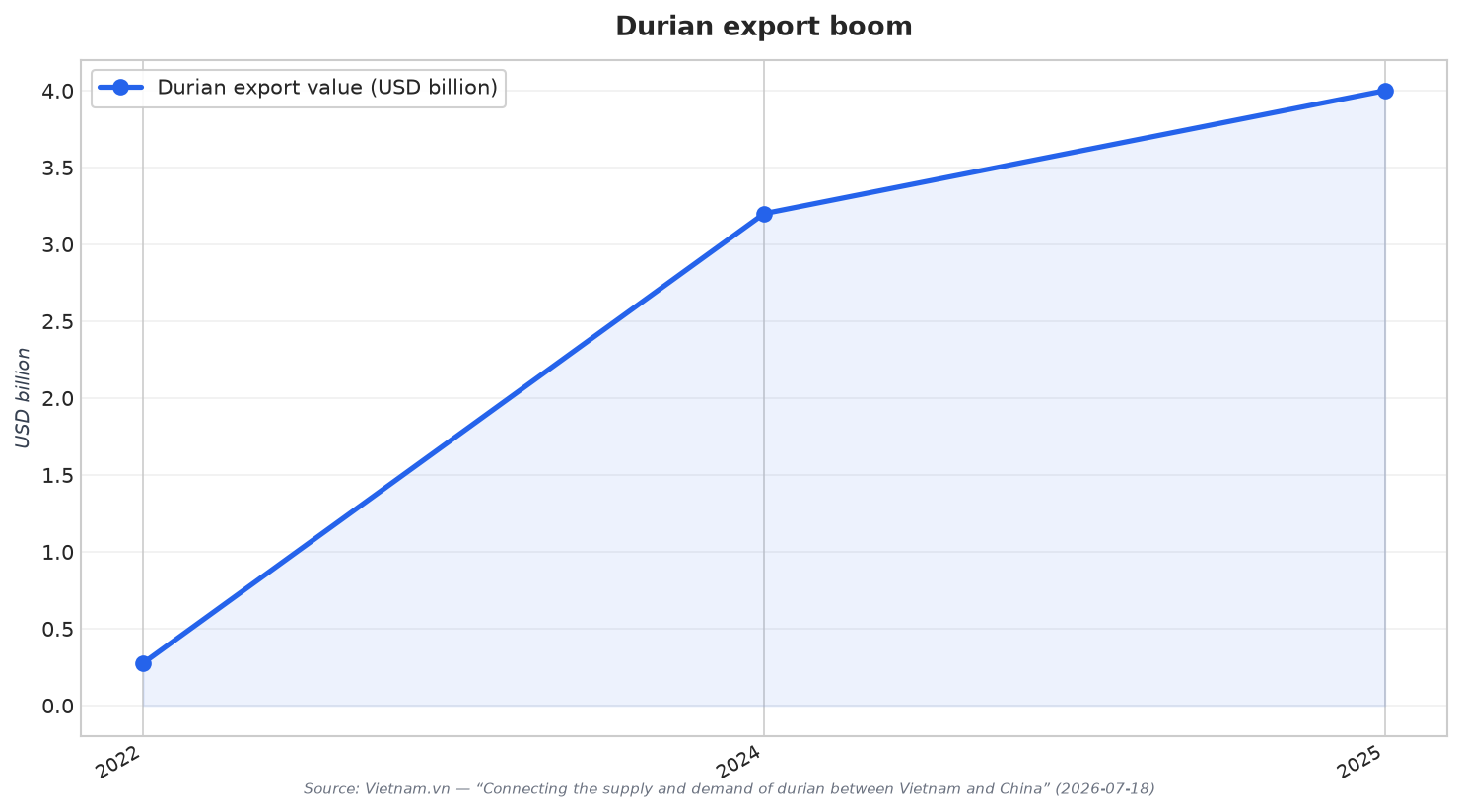
China’s pull is visible in both trade shares and customs-reported values. At the VCCI-HCM event, organizers cited that in the first five months of 2026, Vietnam’s total durian export value reached USD 562.4 million, up 45.2% year on year, with China accounting for USD 492 million, up 76.7%, and representing 87.5% of total durian export turnover. A separate VietnamNet report said that by the end of October, export turnover to China reached nearly USD 3.15 billion, up 13.6% from the same period in 2024, accounting for 94.4% of Vietnam’s total durian exports. In short, the vietnam durian exports china story is fundamentally about one dominant buyer, with the rest of the market growing but still secondary.
Fresh fruit still leads, but freezing and processing are becoming a strategic hedge when prices weaken. The VCCI-HCM workshop figures put fresh durian exports at USD 483.1 million in the first five months of 2026, up 43.4% and equal to 85.9% of total durian export value, while frozen durian reached USD 77.9 million, up 60.3% and nearly 14% of the total. VietnamPlus added that frozen durian is expanding beyond China into markets including the Republic of Korea, Japan, and the US, and said Vietnam’s frozen durian export volume in 2025 was 20 times higher than in 2023. In the first quarter of 2026 alone, frozen durian exports reached nearly 11,600 tonnes at an average price of around USD 4,302 per tonne, up more than 20% year on year.
Why are Vietnam’s durian exports so closely tied to China?
What share of Vietnam’s fruit-and-vegetable export revenue is durian contributing in 2026?
How fast is frozen durian growing compared with fresh shipments?
What is the seasonal advantage behind Vietnam durian exports to China?