
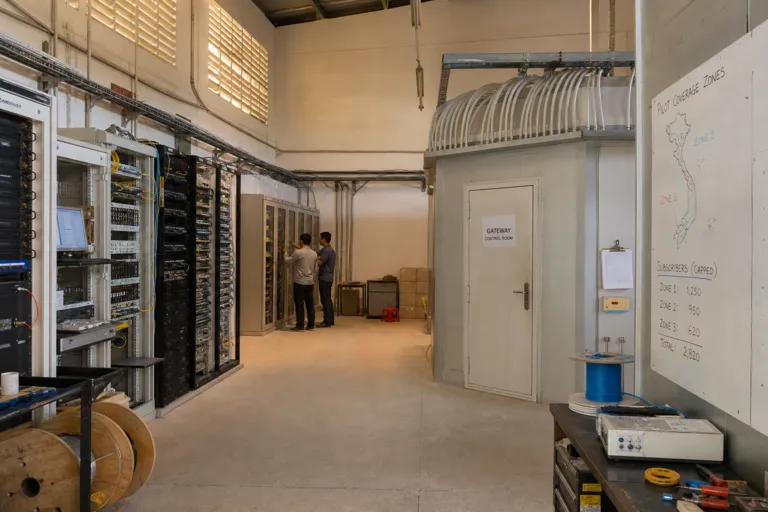
Vietnam’s Starlink decision is not framed as an open-ended market entry. At a Ministry of Science and Technology press briefing on April 1, 2026, VNTA Deputy Director Nguyen Anh Cuong said Starlink was licensed for a controlled pilot. The pilot runs for five years and ends on January 1, 2031. It is capped at 600,000 subscribers. The license also requires four domestic gateway stations in three locations: Phú Thọ, Đà Nẵng, and two sites in Ho Chi Minh City. In practice, the structure makes this a measured test of low-orbit satellite access, not a full rewrite of Vietnam’s broadband landscape.
Vietnamese regulators have also emphasized why the pilot is unlikely to disrupt the existing fixed-line market. One domestic report notes Vietnam has approximately 25 million fixed-line internet subscribers, and describes the 600,000-subscriber ceiling as only a small proportion of that base. Another report puts the implied maximum share at about 2.5%, adding that real uptake could be much less. Those same sources position satellite service as a supporting layer that helps fill hard-to-serve gaps rather than a mass-market substitute. They highlight use cases in remote areas, islands, and environments such as at sea or in the air, where deploying fiber can face cost and terrain obstacles, and where emergency connectivity matters.
Gateway Stations as the Sovereignty Lever
The most consequential part of the Vietnam pilot is the gateway requirement. Officials cite shorter transmission paths, lower latency, and compliance with cybersecurity requirements, as well as spectrum control and interference management. Analysts argue the deeper issue is jurisdiction. By requiring in-country gateway stations, Vietnam can ensure that satellite traffic passes through infrastructure operating under Vietnamese legal authority. Eurasia Review frames this as an early, clear example of a posture that also appears in subsea cable landing conditions and data-localization rules: states use physical placement and jurisdictional rules to preserve control over where data crosses sovereign boundaries. In this view, gateway siting becomes a policy tool for oversight, not just an engineering choice.
This regulatory logic also reflects how satellites fit into global connectivity realities. Geopolitical Monitor notes that submarine telecom cables carry about 99% of international data traffic (citing TeleGeography) and retain latency advantages on many routes. In that framing, satellite systems, including LEO networks, are better understood as resilience overlays: they can support disaster recovery, remote coverage where terrestrial rollout is commercially unviable, and fallback connectivity when coastal or terrestrial infrastructure is damaged. Yet this does not eliminate dependence. Starlink is controlled by SpaceX, a US company, and analysts warn that satellite access can diversify exposure to foreign infrastructure without dissolving it, making licensing conditions the main instrument for managing sovereignty risk.
The trade-off is sharpened by Vietnam’s wider technology and dependency profile as described in one sovereignty-focused analysis. It reports that Vietnam scores 62.1/100 in informational sovereignty and 60.2/100 politically, but 49.2/100 technologically. The same source adds that high-tech imports account for roughly 43% of total imports, while R&D spending remains 0.42% of GDP. Against that backdrop, Vietnam’s approach to the Vietnam Starlink satellite internet pilot reads less like a bet on a single provider and more like an attempt to govern dependence with specific, enforceable constraints—especially over the sovereign endpoints where data enters national territory.
What are the key terms of Vietnam’s Starlink pilot license?
Why does Vietnam require domestic gateway stations for Starlink?
Will Starlink disrupt Vietnam’s fixed-line internet market?
How does satellite connectivity compare with submarine cables in international data traffic?
What is the main digital-sovereignty trade-off in the Vietnam Starlink satellite internet pilot?