Vietnam’s case for battery storage starts with a large gap between ambition and reality. Under the revised Power Development Plan VIII (PDP8), Vietnam targets 10,000 to 16,300 MW (10–16.3 GW) of battery energy storage systems (BESS) by 2030. Yet as of early 2025, installed BESS capacity was still below 100 MW. That mismatch is why investors and manufacturers are positioning early for what one industry report describes as a market that policy targets suggest could reach USD 6 billion by 2030, even before the sector has scaled meaningfully on the ground.
Grid stability and renewable integration are recurring themes in how stakeholders explain the opportunity. As Phan Cong Tien of the Institute of Smart Energy Application Research (iSEAR) put it, “Without storage, it will be difficult to increase the share of renewables while maintaining system stability.” Several market outlooks link BESS demand to intermittent solar and wind, grid modernization, and the need to reduce curtailment. At the same time, high upfront costs are repeatedly cited as a brake, particularly for large standalone projects, even as technology improvements keep changing what is financially viable.
From Targets to Projects: Early Builds, New Rules, and Execution Risk
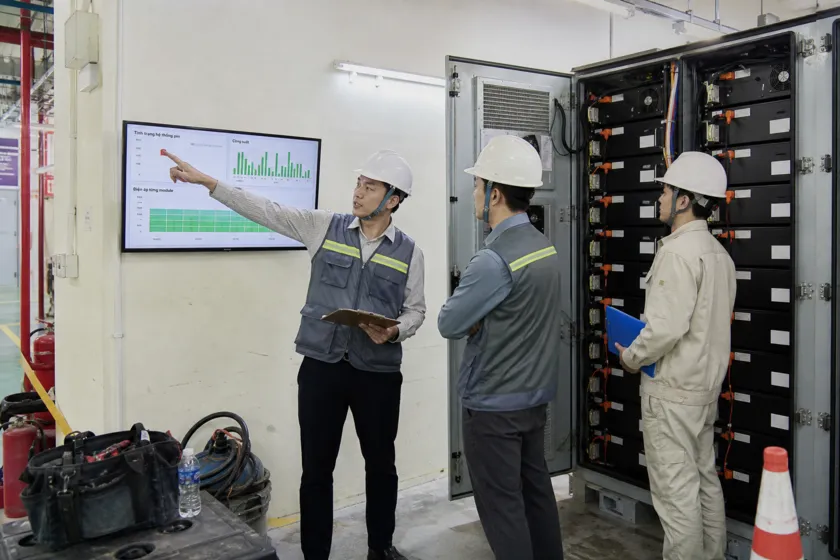
Deployment is beginning to move from planning toward construction, but the pace is still uneven. EVN is reported to have 305 MW under construction in northern Vietnam and a 50 MW pilot underway in Hanoi. Policy is also catching up. Circular 62, effective January 2026, is described as giving standalone BESS a formal pricing framework for the first time. However, the same reporting flags limits that can affect bankability, including annual price approvals, dispatch uncertainty, and the absence of ancillary services mechanisms. In other words, the direction is clearer, but commercial certainty is not complete.
Cost trends help explain why timing matters. A Vietnam battery market outlook notes pack costs for lithium-iron-phosphate systems slid under USD 100 per kWh in 2023, and cites a global average expected to fall another 40% by 2030. Another Vietnam-focused BESS outlook also points to rapid declines in battery costs and performance improvements as catalysts, while still emphasizing that initial investment can slow adoption. Regionally, analysis of the ASEAN energy storage market adds that high upfront costs remain a clear brake, and Vietnam shows this with multiple BESS projects stalled into early 2026 while pricing rules, ancillary compensation, and capacity payments were still being finalized under Circular 62/2025/TT-BCT.
Beyond the grid, Vietnam’s broader battery demand story supports the storage thesis. One Vietnam battery market report states automotive captured 42.5% of the market in 2025 and is forecast to expand at a 13.3% CAGR through 2031, adding about 5 GWh in incremental demand. The same source says industrial stationary batteries accounted for 35% of demand but trail with an 8% CAGR because energy-storage revenues remain policy-constrained. Taken together, that points to a near-term reality: the ecosystem is growing, but scaling Vietnam battery energy storage systems depends as much on market rules and dispatch clarity as on technology and cost curves.
What is Vietnam’s battery storage target under the revised PDP8?
How much battery storage has Vietnam installed so far?
Which near-term BESS projects are reported in Vietnam?
What policy change affects standalone battery storage pricing in Vietnam?
What should investors watch in Vietnam battery energy storage systems?