

Vietnam’s provincial restructuring took effect on July 1, 2025. It merged 63 provinces and cities into 34 provincial-level units, made up of 28 provinces and 6 centrally administered cities. The reform also removed the district level, replacing a three-tier structure with a two-tier system focused on provincial and commune levels. One source frames this as eliminating 696 districts and moving day-to-day local services into a fully digital commune and ward layer. For companies planning site selection, compliance, and expansion, the new administrative map is not cosmetic. It changes how regional decisions move, and where approvals are expected to land.
For investment execution, the most immediate effect is process routing. With districts abolished from July 1, 2025, permits, registrations, and licenses are positioned to be handled at the commune or province level instead of through district bottlenecks. The National Assembly approved the resolution to reduce the provincial-level units from 63 to 34 on June 12, 2025, and another source notes finalization milestones around late August 2025 with new merged provinces starting operations on September 1. Investors should treat this as a documentation and contracting issue as well. Several guides advise using the new province or city name consistently on contracts, visas, and address updates with banks and service providers.
What the New Map Means for Regional Clusters and Economic Zones
Investment strategy in Vietnam often follows clusters rather than single localities, and the mergers are designed to enlarge those clusters. One example cited is Ho Chi Minh City absorbing Binh Duong and Ba Ria–Vung Tau, positioned as a larger unified labor market for factories, logistics, and technology activity. Grokipedia also describes the Southeast Region, anchored by Ho Chi Minh City, as an economic powerhouse that accounts for over 30% of Vietnam’s GDP through manufacturing and services. For the keyword topic of Vietnam provincial mergers and economic zones, the practical takeaway is that zones and industrial footprints may now sit under fewer province-level authorities, potentially enabling integrated planning across a bigger area and fewer overlapping local rules.
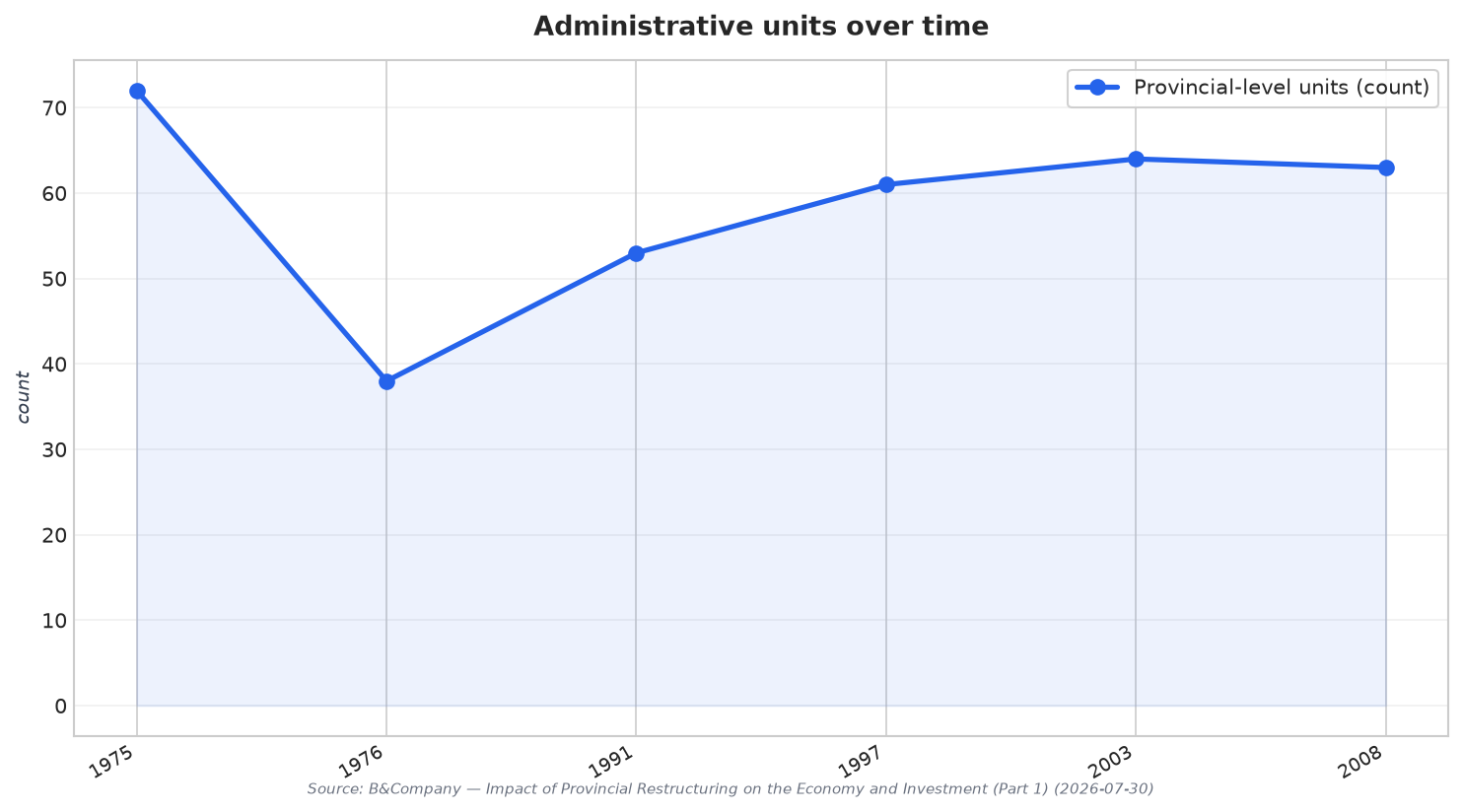
Investors should also read the reform through the lens of national planning regions. Vietnam is divided into seven principal regions used for national planning and statistical reporting: the Red River Delta, Northern Midlands and Mountains, North Central Coast, South Central Coast, Central Highlands, Southeast Region, and Mekong River Delta. These regions now encompass the 34 provincial-level units established through the July 1, 2025 consolidation. A related planning detail is that the Red River Delta has a GRDP growth target of around 11% annually through 2030, supporting national GDP growth objectives of approximately 10% annually for 2026–2030. This does not guarantee outcomes at the project level, but it signals where planners intend to concentrate momentum and infrastructure coordination.
Cost and reinvestment claims are central to the policy narrative, but investors should separate what is stated from what is uncertain in execution. One business-focused source says the government expects to save over $7 billion by 2030 and reinvest it into roads, ports, schools, broadband, fiber networks, and digital services. Another source adds that administrative expenditures previously accounted for 70% of local budgets, implying why streamlining is expected to yield fiscal savings. At the same time, transition risk is real. Commentators anticipate hiccups as district offices wind down and officials adapt to new commune workflows. A disciplined regional investment strategy should assume both faster decision paths and short-term administrative friction while new jurisdictions stabilize.
When did Vietnam’s provincial mergers take effect, and what changed?
How many provincial-level units does Vietnam have after the restructuring?
How do the mergers affect permits and market entry steps for investors?
What does the Vietnam provincial mergers and economic zones topic mean for regional investment strategy?
What savings or budget figures are linked to the reform in the sources?