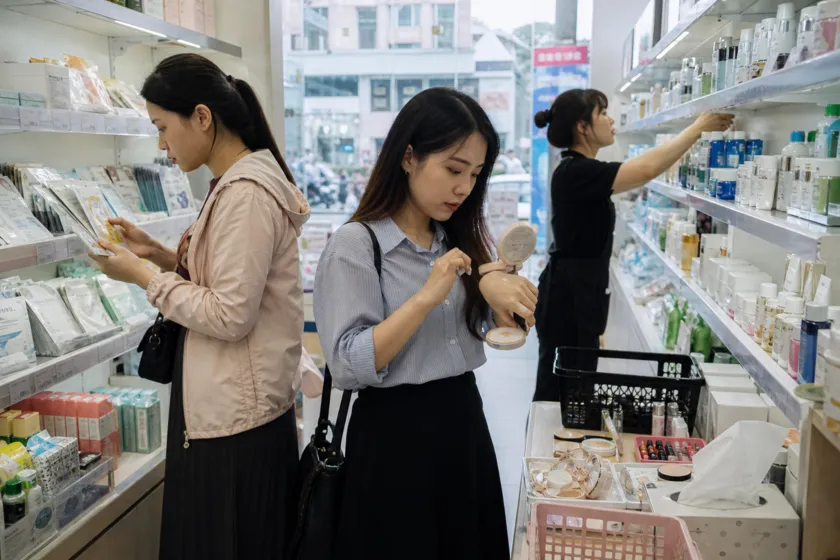
K-beauty’s rise is no longer niche. It is tied to viral content, ingredient talk, and the Korean Wave that also lifted K-pop and K-dramas into global phenomena. The BBC reported South Korea’s domestic beauty market was valued at about $13bn in 2024. It also noted that in the first half of 2025, South Korea overtook France to become the world’s second-largest exporter of beauty products, after the United States. That export momentum matters in Vietnam, where Korean brands have captured 30% of the cosmetics market. Their playbook is built for fast discovery and fast adoption.
Vietnam’s K-beauty boom is closely linked to how modern consumers find products. TikTok, Instagram, and YouTube are flooded with routines, unboxings, and “Get Ready With Me” videos. BBC reporting described how shoppers and influencers dissect ingredient lists and chase looks like “glass skin,” while viral formats can turn a single product into a global signal. One widely discussed example is snail mucin serum, popularized by a TikTok challenge. That wave helped CosRX go global, and it is now owned by Amorepacific, South Korea’s biggest cosmetics company. These viral mechanics travel well, and Vietnam’s market has felt the pull.
Why Korean Brands Keep Winning: Value, Innovation, and Shelf Space
Korean brands have aligned with a value-first mood in beauty. Business of Fashion described customers as “preoccupied with value,” and said many K-beauty brands are cheaper than Western competitors while still delivering similar clinical pedigree. The same theme appears in InsightTrendsWorld, which links K-beauty demand to “high-quality, affordable products,” amplified by social media buzz and the Hallyu effect. Growth figures add context to this commercial engine. Business of Fashion reported Amorepacific grew 6% in the last quarter to $861 million, while APR exploded 124.2% to $378 million. These results help explain why Korean companies push hard into overseas markets like Vietnam.
Distribution has also changed. BBC noted K-beauty sections at global retailers, from Sephora to Boots to Walmart. InsightTrendsWorld described “strategic retail infiltration” through partnerships with major retailers, plus omnichannel growth across physical retail and direct-to-consumer e-commerce. The category is also gaining momentum in the United States, which sets global signals other markets can follow. WWD reported K-beauty dollar sales in the U.S. increased by 37% in the past year alone. Separately, a BBC audio programme said Americans spent as much as $1.7bn on K-beauty in 2024, based on industry estimates. When a category becomes normalized in major retail systems, it becomes easier to scale in Vietnam too.
For the Vietnam K-beauty cosmetics market story, the 30% share is not just about trends. It reflects how Korean brands stack multiple advantages at once: viral discovery, ingredient-led messaging, and broad retail availability. It also reflects how K-beauty’s global position has strengthened, with South Korea becoming the world’s second-largest beauty exporter in the first half of 2025, according to the BBC. For Vietnam, that means more launches, more brand visibility, and more competition on value. The result is a market where Korean cosmetics are not an “import corner,” but a central force shaping what shoppers expect from price, performance, and storytelling.
How did Korean brands capture 30% of Vietnam’s cosmetics market?
What role did social media play in K-beauty’s rise?
What does the Vietnam K-beauty cosmetics market signal about global demand?
Which numbers show K-beauty’s commercial momentum outside Vietnam?
Why do shoppers see K-beauty as good value?