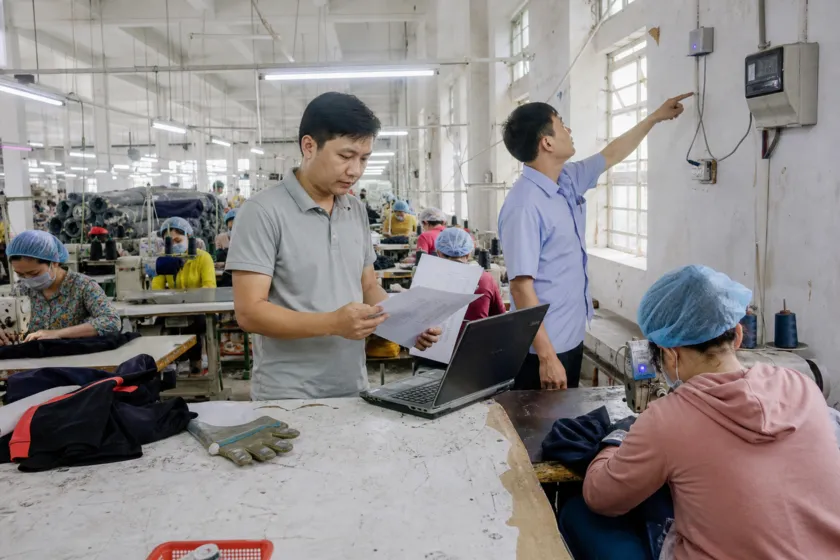
Vietnam’s textile and garment industry is shifting from a low-cost base toward greener and smarter production, while keeping its place among the world’s top three textile exporters. The sector’s export turnover has risen steadily in recent years, and it has a target of 50 billion USD by 2026. Foreign direct investment (FDI) remains a core engine. FDI enterprises account for roughly 60–62% of the sector’s total export value. Investors from the Republic of Korea (RoK), Taiwan (China) and Japan are also accelerating the move to green production and smart technologies, which directly supports Vietnam textile CBAM compliance planning for EU-bound supply chains.
EU policy pressure is rising at the same time. A three-year transition phase for the carbon levy began in 2023, focused on emissions reporting and methodology testing. From 2026, EU importers will need to buy and surrender CBAM certificates that correspond to the CO2 emissions embedded in imported goods, priced in line with the EU’s carbon market at around €70–€100 per tonne of CO2. The European Commission has also proposed tightening loopholes and may apply “default” emissions values that can raise the bill when country data is missing or weak. Separately, companies will have until September 2027 to buy and surrender CBAM certificates to the EU to comply, which still makes 2026 the year when cost exposure becomes real.
Roadmap to Green Compliance: Data First, Then Technology and Product Shifts
The practical compliance sequence starts with the basics: measurement and proof. In manufacturing, green growth is defined as restructuring production to improve resource and energy efficiency, while reducing greenhouse gas emissions and waste. Businesses are advised to build strategies around three concrete actions: technological innovation, energy efficiency, and shifting product structures toward greener goods. For exporters, credible systems matter because compliance relies on collecting emissions data and testing methodologies. If exporters cannot supply high-quality information, they risk losing customers as buyers demand verified numbers rather than general claims.
Vietnam’s textile firms are already being pushed in this direction by automation and digital transformation. As fashion supply chains move toward full automation, technology solution providers are playing a pivotal role in upgrading garment factory capabilities. Industry voices also stress that to enhance future competitiveness, the sector must deepen international cooperation, expand investment in automation, and commit to greener production. This is not only about meeting EU expectations. It is also about keeping margins and market access stable as compliance becomes a non-negotiable requirement, alongside an EU sustainability legislation wave that treats market entry as dependent on verified performance.
In 2026, green compliance should be treated as an investment plan with clear ownership across the supply chain. Vietnam’s advantage is its growing base of high-tech FDI, which already accounts for 60–62% of export value and is tied to green and smart upgrades. The risk is that weak reporting can trigger higher “default” values and higher border costs. The near-term operational goal is simple: build traceable emissions records, then use automation, energy efficiency, and greener product structures to make those records improve year after year. That is how the industry can stay on track for the 50 billion USD export target by 2026 while staying credible in the EU market.
What changes in 2026 make EU CBAM a cost issue for exporters?
How important are FDI firms in Vietnam’s textile exports?
What are the three core actions in Vietnam’s green-growth roadmap for manufacturing?
How should companies approach Vietnam textile CBAM compliance for EU buyers in 2026?
When is the deadline to surrender CBAM certificates after costs begin in 2026?