
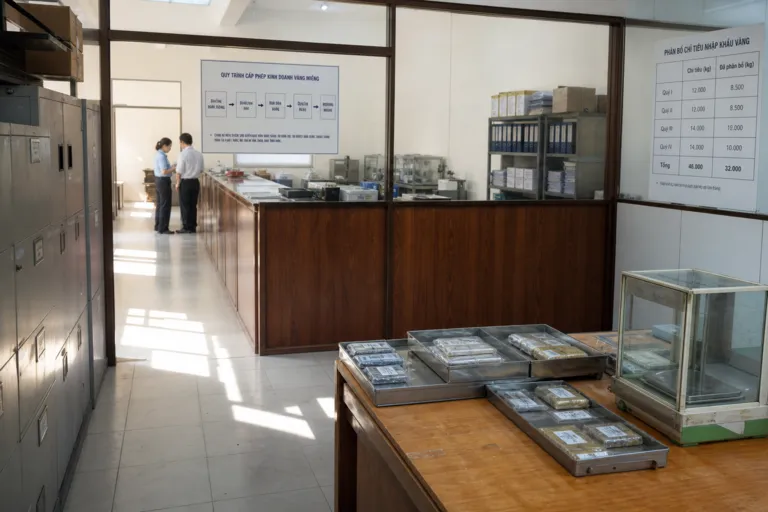
Vietnam’s gold sector has long been shaped by centralized control and the public’s deep reliance on gold as a store of value and a hedge against currency depreciation during uncertain periods. In 2012, Decree 24/2012/ND-CP centralized bullion production and gold import/export under the State Bank of Vietnam (SBV). The Saigon Jewelry Company (SJC) became the sole producer of gold bars, and policymakers framed the approach as a way to curb “goldization” and support monetary stability. Over time, the same model was linked to distortions, including reduced competition, fewer innovation pathways, and domestic prices that could diverge from global benchmarks.
Decree 232/2025/ND-CP marks a structural break. Issued on August 26, 2025, it repeals the clause in Decree 24 that underpinned the state monopoly, eliminating exclusive state control over gold bullion production and also removing monopoly provisions tied to raw gold exports and raw gold imports for bullion production. Gold bullion is also redefined as a product stamped into bars, marked with weight and quality, and carrying the trademark of enterprises and commercial banks authorized by the SBV. Critically, bullion production becomes a conditional business activity that requires an SBV license, shifting the market from a single-producer regime to a tightly regulated licensing system.
What Changes for Banks, Businesses, and Trading Rules
Under the revised framework, qualified commercial banks and enterprises can be permitted by the SBV to produce gold bullion starting October 10, replacing the former state-exclusive mechanism. Eligibility is designed to be restrictive. Enterprises must have at least 1 trillion VND in charter capital (about $41.8 million USD), while banks must have at least 50 trillion VND (approximately $2.1 billion USD), and applicants must already hold SBV precious-metals trading licenses and not be under sanction (or must have resolved past violations). Eight banks were cited as meeting the capital requirement: Vietcombank, BIDV, VietinBank, Agribank, VPBank, Techcombank, MB, and ACB. A representative of the Vietnam Gold Business Association also noted that more than half of the eight approved banks are state-owned, which it said supports stronger oversight under the new model.
Market transparency and enforcement are being emphasized alongside access. One set of measures requires that any purchase or sale above 20 million dong (about $760) per person per day be conducted through bank accounts, while licensed entities must issue electronic invoices and share transaction data with the central bank. Even as private participation expands, the SBV retains control over import quotas, which are tied to macroeconomic conditions and monetary policy. In practice, the policy intent is to reduce speculation, narrow persistent premiums, and limit smuggling and black-market activity by pairing competition with tighter reporting and supervision.
Early signals after Decree 232 were mixed, reflecting both transition risk and expectations of normalization. Reports described immediate volatility, including a spike that took SJC’s selling price to 125.7 million Vietnamese dong per tael (approximately $4,096 per ounce). Another update noted that in early 2026, domestic gold prices showed a narrowing premium over global rates, with SJC gold bars surpassing VND 180 million per tael amid the shift toward a licensing-based regulatory model. Policymakers also moved quickly on market infrastructure: on January 26, 2026, Prime Minister Pham Minh Chinh directed the SBV to fast-track the establishment of a National Gold Exchange as early as February 2026, following surges in domestic gold prices and efforts to curb speculative activity. Together, these steps define the practical direction of Vietnam gold market liberalization: broader entry, but within a system built around licenses, surveillance, and state-set boundaries.
What is the biggest change introduced by Decree 232?
When can qualified banks and enterprises start producing gold bullion under the new rules?
What capital thresholds must applicants meet to qualify?
How does Vietnam gold market liberalization change trading transparency?
What did the government propose in early 2026 to curb speculation?