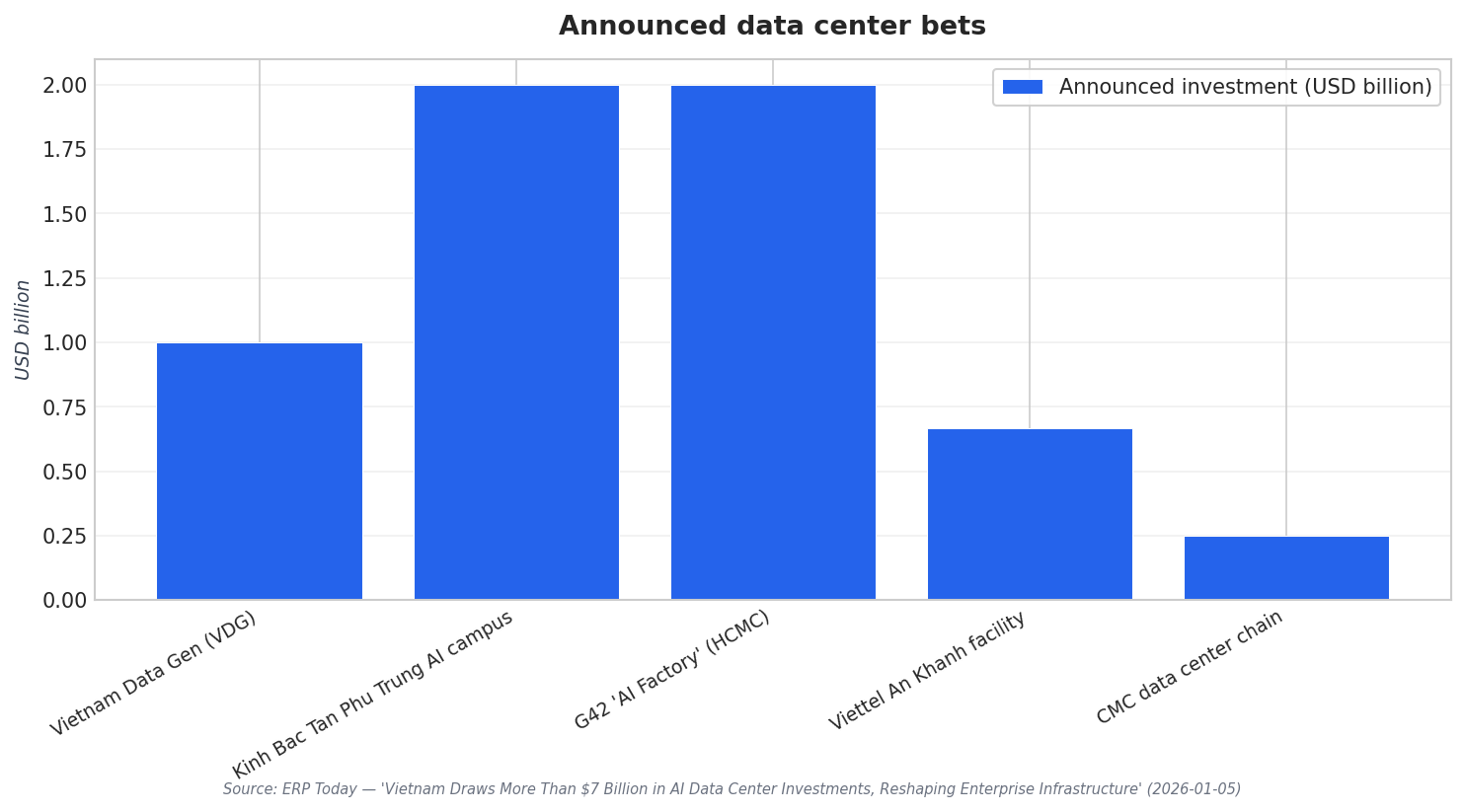
Vietnam’s data center market is moving from early-stage capacity to an investment cycle shaped by AI workloads and new digital rules. In the past six months, announced and proposed AI and data center projects have mobilized more than USD 7 billion nationwide, according to a roundup of recent project disclosures. One of the newest is Vietnam Data Gen (VDG), a joint venture between Create Capital Vietnam and Haimaker.ai, which announced plans for a nationwide AI-focused data center network totaling about USD 1 billion. The plan is staged, starting in Da Nang before expanding nationwide, and is designed for GPU-intensive workloads serving government, banks, telecom operators, and technology firms.
That project pipeline sits alongside a market that multiple sources describe as accelerating quickly from a smaller operating base. One report projects total operational capacity at 104 MW in 2025, and points to planned additional capacity expected to reach 589 MW after 2030, described as a 5.6-fold increase. The same source cites forecasts of Ho Chi Minh City surging by 811% and the former Binh Duong province by 1,071% over that timeframe, while the Vietnam Internet Association (VIA) projects total capacity could approach 1,000 MW by the same period. VietnamPlus also reports expectations that total data centre capacity could nearly double from 525 MW in 2025 to around 1,000 MW by 2030, framing why investors are treating the market as an infrastructure catch-up story.
A Layered Buildout: AI-Specialized, Hyperscale, and International Hubs
Recent announcements show a “layered” strategy, with different facility types targeting different workloads and buyers. On the AI-specialized side, VDG’s phased plan totals 100 MW, beginning with 10–20 MW in Da Nang. Kinh Bac City Development’s Tan Phu Trung AI campus targets large-scale model training with 200 MW and roughly 100,000 GPUs. On the commercial hyperscale side, state-owned Viettel is developing two facilities: 140 MW at Tan Phu Trung and 60 MW at An Khanh, and CMC Corporation is rolling out 120 MW across Hanoi and Ho Chi Minh City for enterprise clients. CMC has also partnered with Samsung C&T on a Ho Chi Minh City hub, with a 30 MW first phase and a planned 100 MW expansion.
International and cross-border oriented builds add another layer to the story. The UAE-based G42 consortium is investing USD 2 billion in a Ho Chi Minh City “AI Factory,” and ST Telemedia’s joint venture with VNG is establishing facilities positioned for multinational clients. Google is also considering a plan to build a data center in Ho Chi Minh City to support cloud services. These projects are landing in a market where electricity and grid requirements can shape feasibility. Mordor Intelligence reports EVN is asking new data center applicants to self-fund 110 kV substations costing USD 8–12 million each, and notes that hybrids pairing rooftop solar with lithium-ion batteries cover less than 5% of critical load during multi-hour outages.
Demand signals are also visible in usage and market-size forecasts, which help explain why Vietnam AI data center investment is being framed as a long-run infrastructure shift rather than a single-cycle build. Vietnam had nearly 79 million internet users at the start of 2024, representing an internet penetration rate of 79.1%, according to cited data. Arizton values the Vietnam data center market at USD 1.04 billion in 2025 and expects it to reach USD 3.19 billion by 2031, at a CAGR of 20.47%. VietnamPlus also cites VNCDC projections that the domestic cloud market could hit USD 1.24 billion by 2025 and USD 2.5 billion by 2029, while noting commentary that industrial electricity prices average 6–10 US cents per kWh and that data center investment and operating costs are about USD 6–7 million per MW.
What new projects are driving Vietnam’s AI data center investment wave?
How much operating and planned capacity is Vietnam tracking?
Which cities are highlighted in the latest buildout plans?
What grid and power hurdles are mentioned for new data centers?
What market forecasts show the scale of growth expectations?