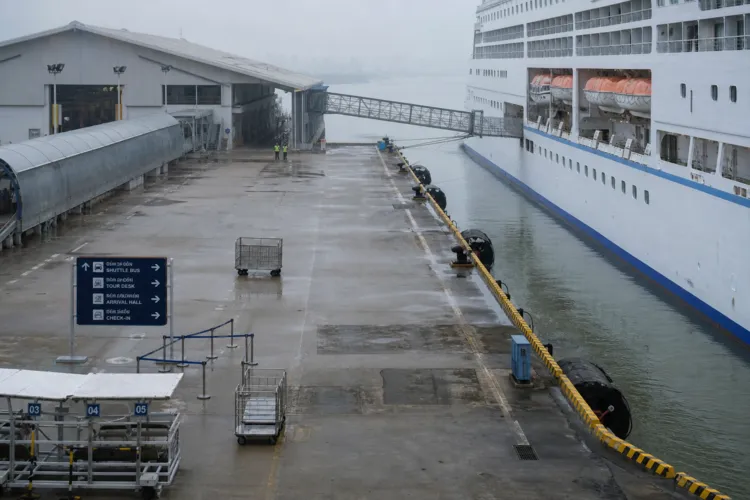
Vietnam’s seaports are growing quickly, and the scale of throughput is reshaping expectations for domestic maritime capability. By 2025, cargo throughput at Vietnam’s seaports is expected to reach about 960 million tons, up 11.1% year on year, including roughly 34 million TEU of containers. Over 2023-2025, projected throughput rises from 761.5 million tons to around 960 million tons, a 26.1% increase. Port infrastructure is also moving up the league table: in the World Bank and S&P Global 2025 container port performance ranking, Cai Mep ranks 11th and Hai Phong ranks 13th, while Cai Mep – Thi Vai is described as capable of receiving container ships up to 24,000 TEU (232,000 DWT).
But strong ports do not automatically translate into a strong national fleet or more domestic control over shipping value. By the end of 2025, Vietnam’s maritime fleet is described as about 1,434 vessels with total deadweight of roughly 9.4 million DWT, including only 45 container ships, with the largest at around 2,000 TEU. Against around 34 million TEU handled through ports annually, the mismatch is clear. Market share in import-export shipping is also reported to be falling: about 11% in 2015, about 8% in 2016-2017, and about 7% in 2023-2024—meaning over 90% of import and export cargo is carried by foreign shipping companies. This gap creates pressure to rebuild capability, but it also creates a commercial opening for yards that can win export orders.
Export Orders Are Arriving—With Higher Standards and Higher Value
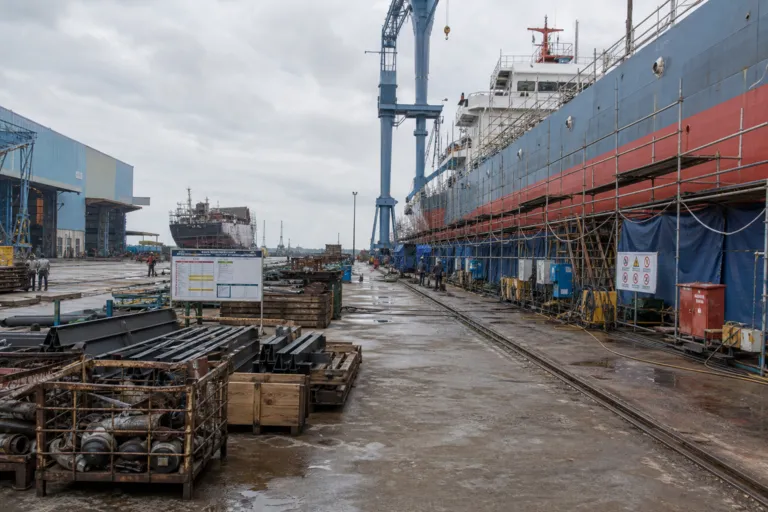
Vietnamese shipyards are already reporting concrete export-linked pipelines. At Pha Rung Shipyard in October, workers were building a 13,000 DWT oil and chemical tanker within a series of ten vessels for a South Korean shipowner starting in Q3 2023, and the yard also signed contracts and memoranda of understanding for ten 6,500 DWT oil and chemical tankers for another South Korean partner, securing work through 2030. For each 13,000 DWT vessel, labor cost is cited at about $7 million within a total vessel value of roughly $28 million. Elsewhere, Nam Trieu is building two 65,000-ton cargo ships and completed a 2,300 cubic meter dredger for Dutch partner IHC, while Ha Long Shipbuilding is focusing on offshore engineering service vessels and describes an orientation toward export vessel lines with high technical requirements.
The pricing difference between domestic and export projects explains why this matters for investment and skills. Some domestic orders are described at labor cost of about 20,000 VND per kilogram of steel, while export ships can reach 3 USD per kilogram or more, equivalent to roughly 80,000 to 90,000 VND per kilogram. Higher value also brings stricter requirements on technical specifications, quality, safety, timelines, and workforce capability. Ha Long’s experience building CSOV vessels for Damen included support in safety control, inspection procedures, problem-solving, and production management, signaling how export delivery often comes with embedded know-how transfer.
Whether port growth becomes a sustained export engine will depend on policy support, technology, and the green transition. Industry voices argue that suitable support policies are needed so businesses can invest systematically and meet rising market demands, including tools such as export financing, credit guarantees, and technology development programs. Digital modernization is also framed as a lever: a report on Vietnam’s digital shipyard market cites shipbuilding capacity of around 3.5 million tons per year and notes government allocation of $1.8 billion for port and shipyard upgrades in future. At the same time, the global market is shifting toward “green ports” and “green fleets,” with Vietnam under pressure to align with the International Maritime Organization’s emissions reduction strategy and a net-zero-by-2050 commitment referenced in national discussions. For the Vietnam shipbuilding industry, the opportunity is visible in today’s order books, but the conversion into durable export competitiveness will be decided by execution across skills, standards, supply chains, and financing.
How fast is Vietnam’s port throughput growing through 2025?
What does the fleet-versus-ports gap look like by the end of 2025?
What export shipbuilding orders are Vietnamese yards reporting?
Why are export ships financially attractive for yards compared with domestic orders?
What needs to happen for the Vietnam shipbuilding industry to turn port growth into export competitiveness?