Vietnam’s residential real estate market was valued at USD 34.12 billion in 2026 and is projected to reach USD 58.93 billion by 2031, according to Mordor Intelligence, reflecting an 11.55% CAGR. Transport upgrades are repeatedly cited as a key demand funnel, and TOD is becoming a practical way to connect that demand to new supply. The context is rapid urbanization: Vietnam’s 2024 census confirmed an urbanization rate of 38.2% and annual urban population growth of 3.06%. In that environment, metro investment is not just mobility. It is increasingly treated as a development blueprint that shifts where people buy, rent, and work.
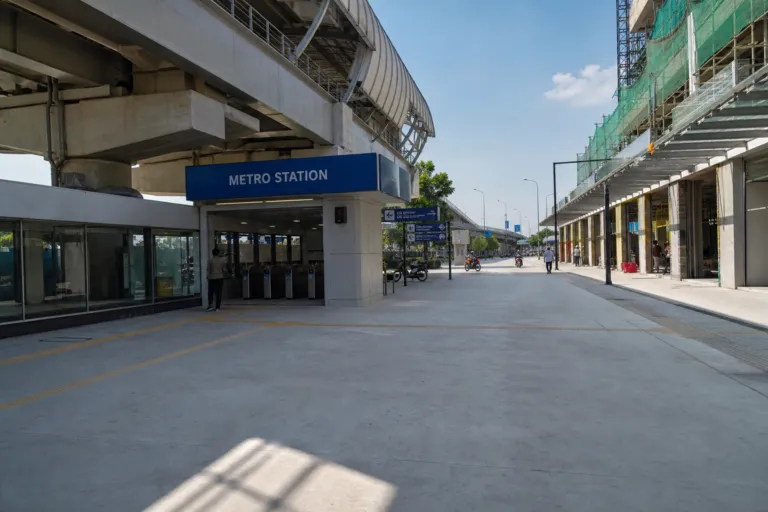
Recent milestones changed the on-the-ground reality. Metro projects began operations in November 2021 in Hanoi and December 2024 in Ho Chi Minh City, helping residents reassess what “good connectivity” means. JLL Vietnam described how HCMC’s real estate market stayed tight for decades: from 1990–2015, development rarely moved beyond Ring Road 2 and clustered within 10 kilometres of the city central, following road infrastructure while transit-oriented projects remained absent. Over the metro construction decade, both cities saw numerous projects appear along urban rail lines. JLL estimates projects within a 10-minute walk of metro stations now account for 14–16% of total commercial real estate supply and 4–9% of residential supply in both markets.
Pricing Signals: Metro Adjacency Starts to Reprice the Map
Pricing shifts are one of the clearest signals that transit access is turning into a measurable real estate factor. JLL reported that metro-adjacent projects recorded average price increases of about USD 200–250 per sq m within one year after lines began operations. JLL linked that to an annual growth rate of 8% for metro-adjacent real estate, versus a 4% market average growth recorded in Ho Chi Minh City in 2025. In Hanoi, JLL reported projects near metro recorded a 19% price increase compared with a market average of 12% in 2022. These differences help explain why the conversation about the Vietnam transit oriented development metro model is moving from planning theory to pricing reality.
Policy and planning are reinforcing the same direction. VnEconomy reported that from 2025 onward, the Vietnamese government embraced TOD to reduce density in inner urban areas, alongside integrated townships along ring roads. VietnamPlus emphasized that TOD focuses on multifunctional urban areas within walking distance of public transport hubs, especially metro stations, and positioned urban rail as the “backbone” for reshaping long-term development. Under Hanoi’s master plan to 2030, the city’s permanent population is projected at around 11 million with an urbanisation rate of approximately 70%, adding pressure to transport and land. Nhan Dan also reported that Ha Noi launched simultaneous construction of five urban metro lines with a combined investment of more than 1.3 quadrillion VND.
The market is also being pulled outward by ring roads and designated TOD zones. Realtique highlighted connectivity as “the single most important variable” reshaping housing demand, with land value shifting toward ring-road corridors and outer areas in both Hanoi and HCMC. In HCMC, it pointed to five TOD zones along Metro Line 2 totaling 940 ha, alongside the Ring Road 3 system, as forming new growth poles. These corridor effects matter because apartments and condominiums already led with 70% of Vietnam’s residential real estate market share in 2025, and mid-market units captured 48% of market size that year, per Mordor Intelligence. As metro-linked nodes grow, the most competitive projects are increasingly those that mix homes, services, and employment within easy station access.
What does transit-oriented development mean around metro stations in Vietnam?
How much of current supply is near metro stations in Hanoi and HCMC?
What price impacts have been reported for metro-adjacent projects?
When did metro operations begin in Hanoi and Ho Chi Minh City?
How is the Vietnam transit-oriented development and metro trend shaping growth corridors in HCMC?