

Vietnam’s adoption of a global minimum tax signals a shift in how the country positions itself in FDI competition. Under Decree No. 236/2025/ND-CP, effective October 15, 2025, Vietnam applies a 15% global minimum tax rate to multinational enterprises with consolidated revenues of EUR 750 million (USD 877.87 million) or more. VietnamPlus notes that, after accounting for incentives, the effective corporate tax rate for many firms had been around 12.5%, below the 15% threshold. That gap is exactly what the new framework reduces, especially when tax authorities collect a top-up tax to bring the total burden to at least 15% for affected investors.
In the near term, Vietnam is managing two priorities at once: maintaining investor confidence and upgrading the “quality” of inflows. VietnamPlus reports that in the first nine months, Vietnam licensed 2,926 new FDI projects from 82 countries and territories, with newly registered capital of USD 12.39 billion, down 8.6%. Even with the slight decline in capital, the rising number of projects is framed as continued confidence, including from small- and medium-sized enterprises expanding in Vietnam. At the same time, policymakers expect the minimum tax to improve fairness and curb base erosion, even if it slightly affects future inflows.
From Low Tax Rates to “Right Investment” and Compliance-Ready Incentives
Several sources describe why the policy change is tied to tighter scrutiny and a more selective approach. VietnamPlus cites the Ministry of Finance saying that in 2023, 56% of FDI firms in Vietnam reported losses, a 21% increase from the previous year, even though revenue and assets rose. It also reports over 5,000 firms with negative equity and accumulated losses reaching VND 908 trillion (USD 34.48 billion), which it links to potential “profit shifting.” This context helps explain why Vietnam’s new rules emphasize a level playing field, and why the global minimum tax is presented as both a revenue tool and a sovereignty tool.
The practical rebuild of incentives is also about protecting eligibility and shifting benefits into areas that remain meaningful under the new tax baseline. Acclime Vietnam explains that Vietnam offers preferential CIT rates of 10% and 17% and tax holidays for qualifying projects under the 2025 CIT Law, and also notes tiered SME rates of 15% and 17%. But large MNE groups with global revenues above EUR 750 million can see preferential rates below 15% neutralised by Vietnam’s global minimum tax rules. Acclime also warns that incentives can be lost if qualifying conditions are breached, if income is not properly separated in the accounts, or if restricted losses are offset against incentivised income—making compliance and accounting structure part of the new incentive strategy.
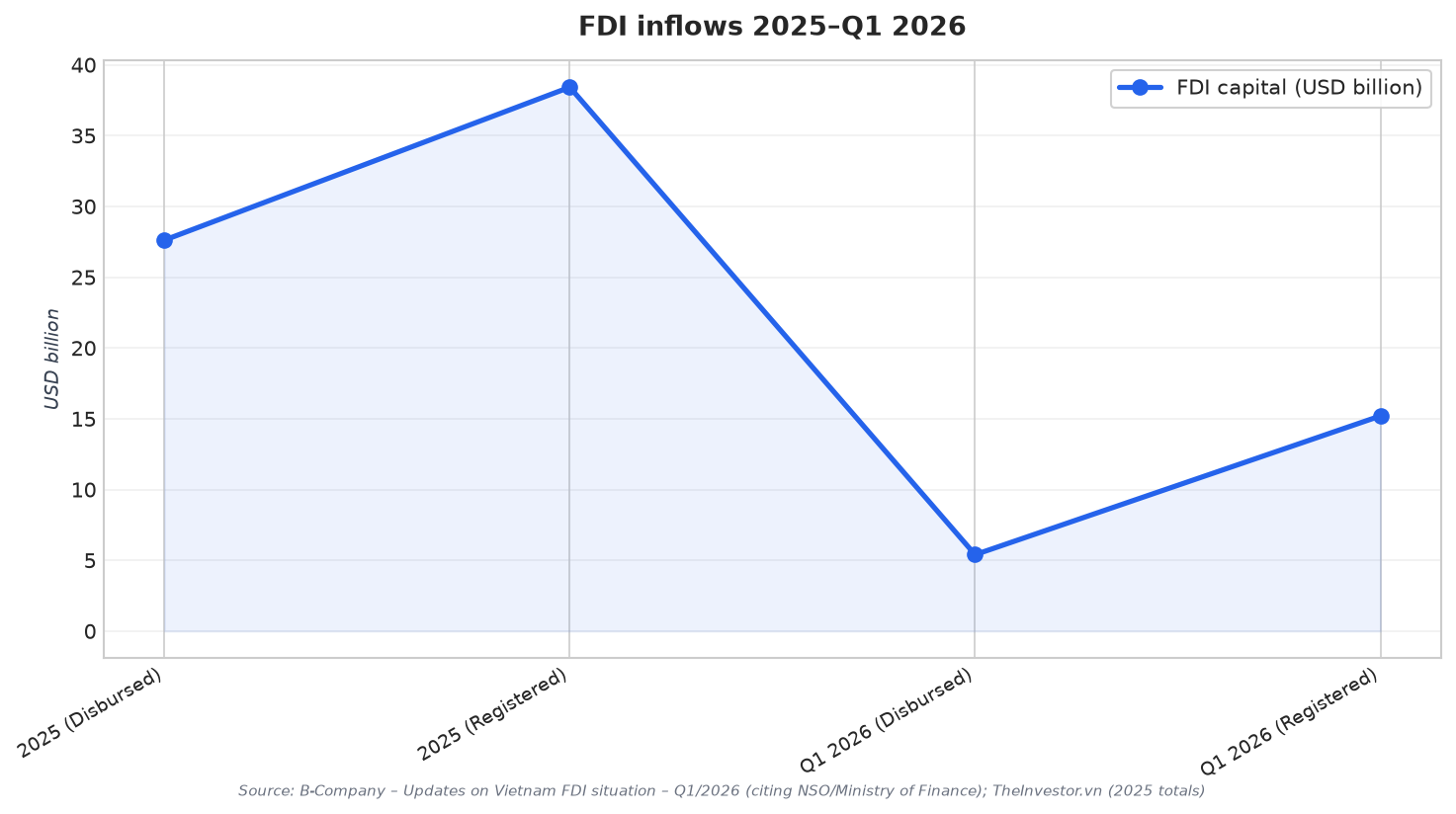
Looking forward, Vietnam’s pitch increasingly centers on execution capacity, infrastructure, and higher-value projects, not just statutory tax rates. The Investor writes that traditional tax incentives are losing effectiveness and that Vietnam must compete based on institutional quality, infrastructure, public services, and implementation capacity, while prioritizing high-tech sectors, clean energy, data, and green logistics. Momentum remains visible in the flow of capital. The Investor reports total registered FDI of about USD 38.42 billion in 2025 and disbursed capital of USD 27.62 billion, while B-Company reports Q1 2026 registered FDI of about USD 15.2 billion (up 42.9% year-on-year) and disbursed capital of USD 5.4 billion, the highest first-quarter level in five years. In this setting, the Vietnam global minimum tax Pillar Two era becomes less about “discounted tax,” and more about targeted support, compliance-ready incentives, and attracting investment that upgrades the value chain.
What is Vietnam’s 15% global minimum tax and who does it apply to?
How does the top-up tax affect existing corporate income tax incentives?
What recent figures show Vietnam’s FDI momentum alongside the policy shift?
What are common ways FDI projects can lose Vietnam corporate tax incentives?
How is Vietnam repositioning incentives under the Vietnam global minimum tax Pillar Two framework?