Vietnam’s e-invoice regime has applied nationwide since July 1, 2022. From July 1, 2026, the operative framework sits in Decree 254/2026/ND-CP and Circular 91/2026/TT-BTC, issued under the Law on Tax Administration No. 108/2025/QH15. These rules replaced Decree 123/2020/ND-CP and related amending instruments, so older references can be misleading for finance teams. In practice, the direction is clear. Most sales must be supported by electronic invoices and sent through the tax authority’s required channels, shifting compliance from periodic paperwork toward continuous transaction capture.
For many businesses, the default is an electronic invoice that carries the tax authority’s code. Non-coded e-invoices are available only to enterprises in listed sectors if their systems meet technical conditions, and they are never available to taxpayers the authority classifies as high risk. Under Decree 254 and Circular 91, if a non-coded user is notified as high risk, the business must move to coded invoices within 10 working days. A return to non-coded status is not immediate. The business may apply to switch back only after 12 months, reinforcing how risk status directly controls invoicing options.
Where the Rules Hit Hardest: Timing, POS Sales, and Risk Signals
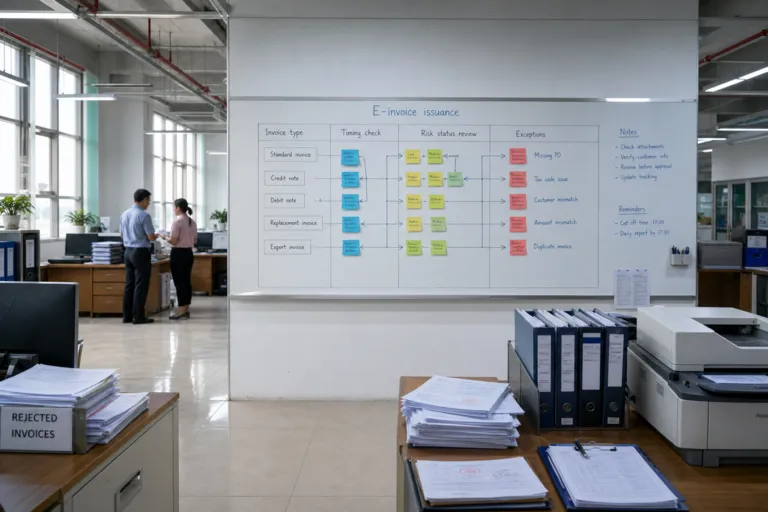
The rules also tighten the “when” of invoicing. Invoice timing follows the transaction, not the payment. Goods are invoiced when ownership or the right to use them passes to the buyer. Services are invoiced when completed, or earlier if payment is collected first. Export invoices follow a specific constraint as well: they must be issued no later than the next working day after customs clearance. This transaction-based timing makes gaps easier to detect when authorities compare commercial activity with declared tax outcomes.
Cash-register e-invoices add an operational layer for consumer-facing sectors. They are required for sellers dealing directly with consumers in retail, food and beverage, hotels, passenger transport, entertainment, and personal services, unless the seller already uses coded or non-coded e-invoices. Business households and business individuals with annual revenue over VND 1 billion must use either cash-register e-invoices or coded e-invoices. A cash-register e-invoice does not require a digital signature, but each sale gets its own invoice when it happens. The day’s invoice data is transmitted to the tax authority at the end of the day, so compliance becomes part of the cashier workflow, exception handling, and reconciliation.
This shift is at the center of Vietnam e-invoice tax digitalization because invoice data is increasingly used as a core input for supervision. Vietnam’s tax administration is moving from planned audits to data-driven risk management, with e-invoice data matched against bank cash flows to determine actual tax liabilities. The 2025 Law on Tax Administration puts mechanisms into law, including grouping taxpayers by compliance history, remote audits on electronic data, and automated refunds, exemptions, and reductions. The result is a compliance environment where mismatches across ledgers, e-invoice data, returns, and bank records can trigger questions, and identity and risk management receive greater emphasis.
When did e-invoicing become mandatory nationwide in Vietnam?
What is the default e-invoice type under the 2026 framework?
What happens if a business using non-coded e-invoices is classified as high risk?
Which businesses must use cash-register e-invoices, and what is the VND threshold?
How does Vietnam’s e-invoice-led tax digitalization change audits for businesses?