Vietnam is stepping into the execution phase of its clean-fuels roadmap. A key signal came with the official launch of the country’s first National Green Hydrogen Hub at the Vietnamese-German University (VGU). The hub was established under the German-supported H2Uppp programme, implemented by GIZ. The stated focus is innovation, technology transfer, and international collaboration in green hydrogen production and applications. Industry commentary in the same update described the hub as a shift from policy planning to practical implementation, with participation from global clean energy companies and an expectation of attracting foreign investment.
This matters for export narratives because clean molecules need bankable project structures and credible pathways to scale. Analysts cited Vietnam’s abundant renewable energy potential as a competitive advantage for low-cost green hydrogen production, and as a basis for positioning Vietnam as a future regional hub for clean fuel exports. The export conversation is increasingly tied to derivatives, not just hydrogen. Green ammonia, in particular, is framed as a practical carrier for storage and transportation, converting renewable electricity into hydrogen-based compounds that can move through global supply chains more easily than gaseous hydrogen in many cases.
Why Hydrogen-to-Ammonia Integration Supports Export Scale
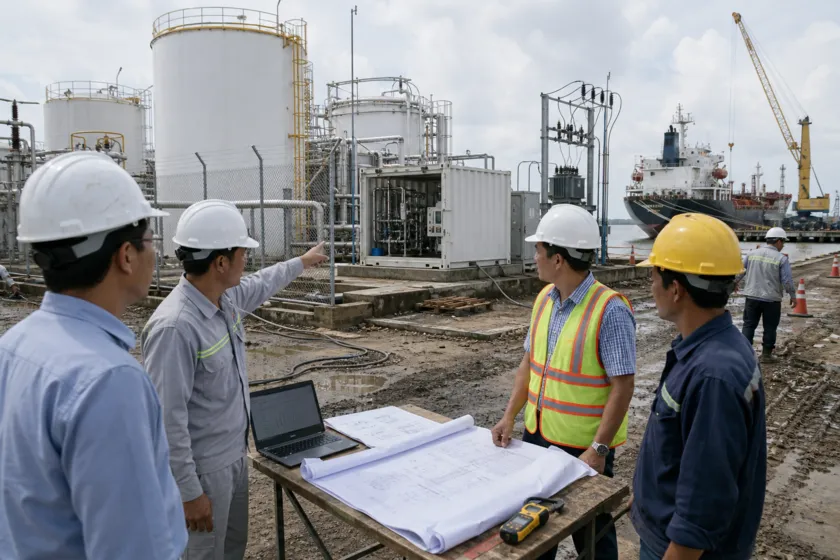
Across the sector, a “green hydrogen and ammonia project” is described as an integrated model. It combines wind-solar power generation, hydrogen production through water electrolysis, and green ammonia synthesis. The goal is to convert renewable electricity into hydrogen and hydrogen-based compounds for storage and transportation. This system-level design is repeatedly positioned as a way to use renewable power more effectively, because production can be synchronized with variable upstream generation. One cited view is that a fully dynamic green plant can seamlessly match fluctuating renewable supply, ensuring every kilowatt-hour of green electricity can be maximally utilized while supporting holistic system stability.
For export-oriented locations such as Phu My and Tra Vinh, this integrated approach aligns with where demand is expected to form first. Green ammonia is described as being extensively utilized in maritime fuel, industrial feedstock, and fertilizer production, with zero carbon emissions in use. That makes it relevant to hard-to-abate segments that need scalable fuel logistics. The same sources also note that modular hydrogen-ammonia plants are easily replicable globally, which can accelerate commercialization of green hydrogen and derivatives. For Vietnam’s emerging export story, replicability and the ability to package projects in repeatable blocks can reduce execution risk and speed learning curves.
Vietnam’s broader energy-transition context also shapes investor confidence. Vietnam’s net-zero emissions pledge is referenced with a 2050 timeline. Separately, LNG-to-power projects in the country, including Nhon Trach 3 and 4, are expected to support the transition while contributing to that 2050 net-zero pledge. In practice, export-facing clean-molecule projects still need policy clarity, buyers, and infrastructure, but the direction of travel is becoming clearer. With the new hydrogen hub intended to support domestic decarbonisation goals while opening opportunities in global energy markets, Vietnam’s green hydrogen and ammonia pathway is becoming a more concrete platform for export ambitions.
What does Vietnam’s National Green Hydrogen Hub aim to do?
How do green hydrogen and green ammonia projects typically work?
Why is green ammonia highlighted for export markets?
How does the Vietnam green hydrogen ammonia push connect to net-zero goals?