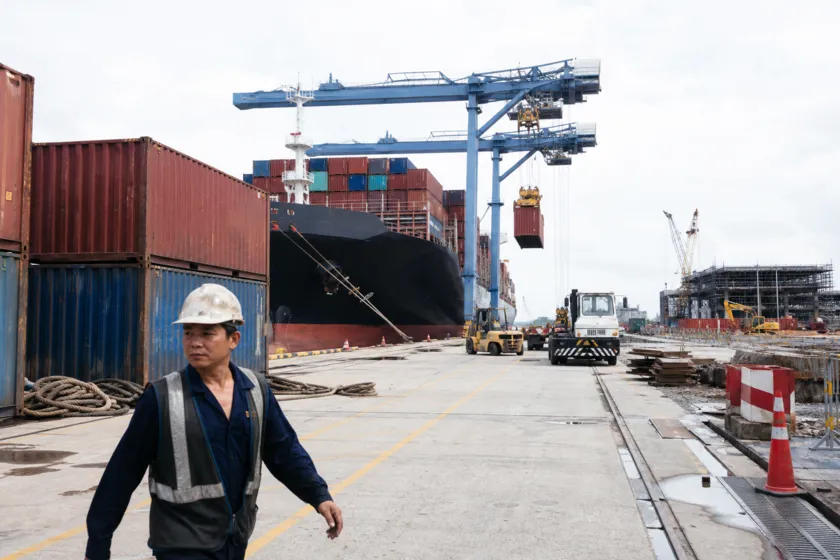
The Cai Mep–Thi Vai port cluster has become a focal point for deepwater container growth in southern Vietnam, close to Ho Chi Minh City. Global carriers and terminal operators already use the cluster for Vietnam-linked services. MSC, described as the world’s largest ocean carrier, operates in the Cai Mep port cluster and handles more than one million TEU of Vietnamese imports and exports each year. The cluster is also tied to long-term plans for Ho Chi Minh City to raise its status as a global maritime hub, with a push to develop national gateway functions and international transshipment capability.
Major terminal capability in the cluster is already positioned for very large ships. APM Terminals is involved in the Cai Mep International Terminal, which can handle 18,000-plus TEU vessels with up to 214,000 dwt. The cited capacity for Cai Mep is 2.1 million TEU. Separately, CMA CGM Group is expanding Gemalink, a joint venture terminal in the Cai Mep port complex. Gemalink has been operating since 2021 and is currently handling 1.7 million TEU on a yearly basis while operating at full capacity, according to the report.
What Expansions Mean for Capacity, Equipment, and Ultra-Large Calls
Expansion plans show how the cluster is being tuned for bigger volumes and more intensive operations. CMA CGM’s Gemalink terminal is planned to increase capacity to approximately 3 million TEU, up from 1.7 million TEU, once the expansion is completed by end-2027. The project includes extending quay length by a total of 450 metres in two parts. It also expands the container yard to 44 hectares from 32 hectares. The terminal plans to add five ship-to-shore cranes, bringing the total to 13 units, alongside additional yard equipment.
City-backed investments also point to further scale around Cai Mep–Thi Vai. Ho Chi Minh City approved expansion to the Cai Mep cluster that includes development of the new Cai Mep Ha port project at a cost of $1.95 billion. The report says this port will raise the city’s port system capacity by 10.8 million TEU annually. It is designed to serve a dual role as a national gateway and as an international transshipment hub. In this context, the keyword topic of a Vietnam Cai Mep deepwater port is increasingly defined by both ship size readiness and system-wide capacity additions.
Developments at the mouth of the Cai Mep River reinforce the same direction toward ultra-large container vessel handling. The $4.9 billion Can Gio International project is planned over an area of 570 hectares on an offshore islet, Go Con Sho, at the mouth of the Cai Mep River. In its first phase, it is planned to have up to four berths capable of handling vessels of up to 250,000 tons, with a longer-term goal of 13 berths and a total quay length of 7.5 kilometers. Capacity is designed to reach 4.8 million TEU by 2030 and 16.9 million TEU by 2047, aligning with ambitions to become a major international transshipment hub.
How large are the ships Cai Mep International Terminal can handle?
What is Gemalink’s current and planned capacity in Cai Mep?
How much added capacity is expected from the Cai Mep Ha port project?
What does the Can Gio project add near the Cai Mep River mouth?
Why is the Vietnam Cai Mep deepwater port topic attracting major carriers and terminal operators?