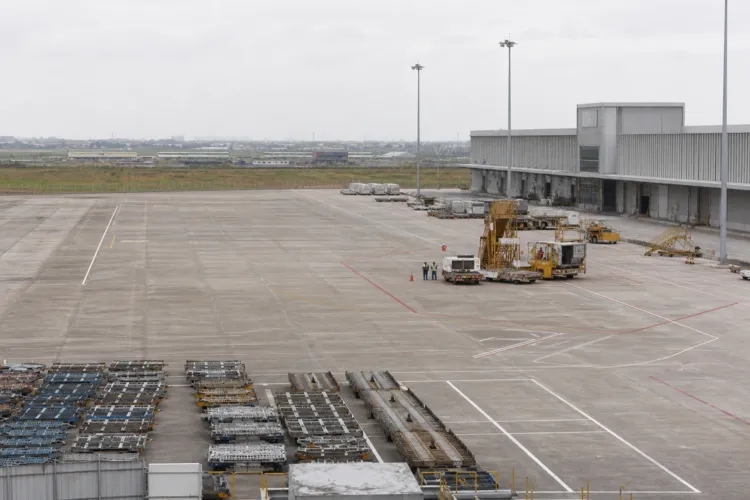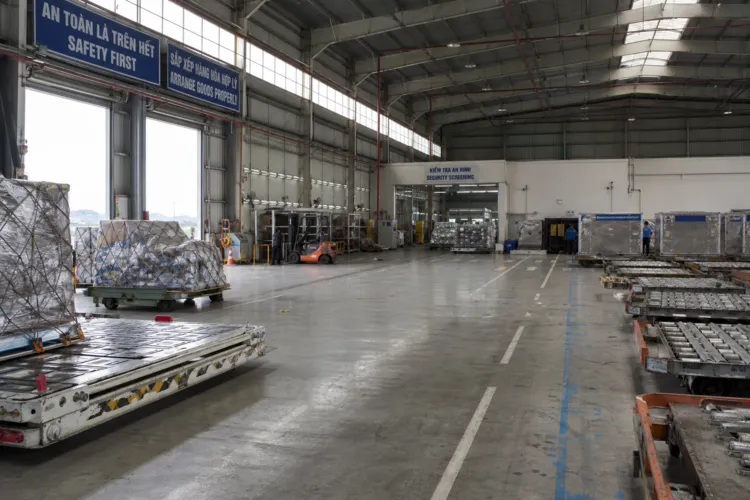

Vietnam’s logistics story is often told from the coastline inward, but the next wave of resilience is being built away from the seaport gates. With over 3,200 kilometres of coastline and major ports spread across the north, centre, and south, operators are pushing toward end-to-end networks that connect roadways, seaways, airways, and railways. That multimodal push is happening as port cargo scales up. Seaport cargo throughput was estimated at 864.4 million tons in 2024 in Vietnam, underscoring how much volume must be staged, cleared, and moved beyond the quay.
The operational pressure is clearest where drayage demand is concentrated. In Southern Vietnam, Cat Lai and Hiep Phuoc ports processed more than 191 million t of box cargo in the first ten months of 2024, while industrial-zone occupancy exceeds 92%. When peak congestion hits, shippers face USD 150–200 surcharges per container. Those frictions are steering cargo toward inland depots and night-time slots, because the value is not only storage, but also smoother gate access, faster truck turns, and fewer cascading delays across factory-linked distribution.
From Port Relief to Network Design: The New Role of Inland Depots
Instead of acting as a simple overflow yard, the emerging Vietnam inland container depot network is increasingly tied to customs, planning, and corridor design. One constraint is that inland mode integration remains uneven, reducing end-to-end cost efficiency even as ports expand. Market participants are responding with inland container-depot build-outs and more digital operations. Nationwide RFID tolling and digital carnets on the China and Laos borders are cited as mechanisms that lift asset utilization and shorten transit times, tilting margin expansion toward carriers that digitize operations rather than those competing on freight rates alone.
Government direction and compliance also shape where inland depots can create the most value. Vietnam’s Ministry of Transport is tightening axle-load enforcement across the Red River and Mekong Delta corridors, forcing fleet operators to reconfigure truck configurations and terminal access protocols. At the same time, the Logistics Development Strategy mandates digital customs platforms and green fleet conversion timelines that filter participant eligibility. These requirements matter because inland depots sit at the intersection of trucking rules, bonded warehouse protocols, and customs clearance workflows that determine whether cargo can move seamlessly to ports such as Cai Mep and Lach Huyen.
Commercially, inland depots sit inside a broader shift toward outsourced, integrated logistics. The 3PL segment accounts for the largest share of Vietnam’s logistics market and is also described as the fastest-growing, as manufacturers and retailers outsource warehousing, distribution, and supply chain management. In Vietnam’s 3PL market, average realized 3PL revenue per shipment-equivalent unit remains near USD 2.50 in 2024 and edges upward as managed warehousing, fulfillment, and cold chain gain mix share. That shift aligns with rising needs in specialized handling, including fruit and vegetable exports expected to reach about USD 7.2 Bn in 2024, which expands demand for pre-cooling, reefer storage, and compliant cross-border handling.
Global context reinforces why inland depots are getting strategic attention. The inland container depot and dry port market was valued at USD 38.74 billion in 2025 and is projected to reach USD 69.73 billion by 2035, at a CAGR of 6.1% from 2026 to 2035. In emerging markets, PPP development is described as a standard model, with governments enabling land, rail links, and customs presence while private operators bring equipment, operations, bonded warehouses, and shipping-line relationships. Within Vietnam, competitive dynamics also point inland: A.P. Moller - Maersk is described as integrating ocean freight with inland depot coverage across northern and southern Vietnam, reflecting how inland nodes are becoming true supply-chain linchpins rather than auxiliary facilities.
Why are inland container depots gaining importance in Vietnam’s logistics system?
What port-side congestion signals are pushing shippers toward inland depots?
How do policy and compliance affect inland depot operations?
How is the Vietnam inland container depot network linked to 3PL growth?
What global trend supports investment in inland container depots and dry ports?