
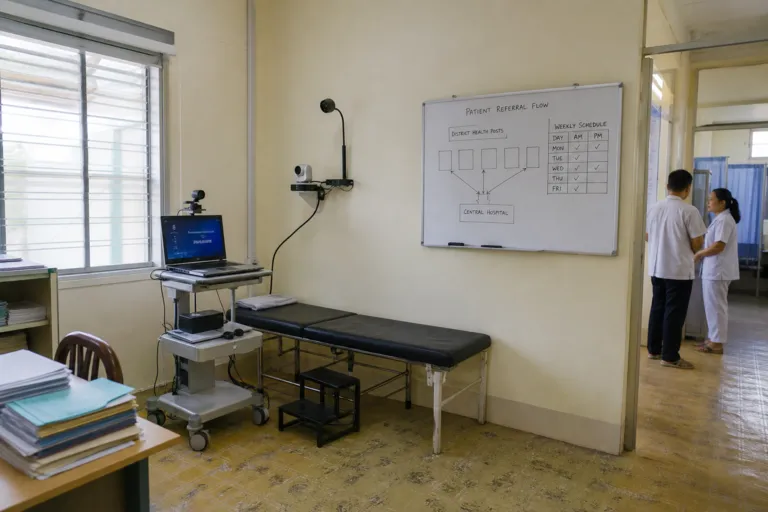
Care at a distance is becoming a practical answer to Vietnam’s uneven access to specialists across provinces. Market analysis notes that many rural areas face limited access to healthcare facilities and specialists, and telemedicine helps patients consult with doctors remotely and reduce long travel distances. The country’s broader digital health market already includes teleconsultation, remote monitoring, and connected-care services, linking remote touchpoints with hospital systems and patient-facing tools. A large online base supports this shift, with 85.6 million internet users and 84.2% internet penetration in 2025, creating reach for digital triage, appointment booking, medication management, and post-discharge engagement.
In parallel, Vietnam’s healthcare financing environment is building a wider runway for remote care pathways that can scale beyond big-city hospitals. Vietnam’s social health insurance system, administered by Vietnam Social Security, funded 186.2 million outpatient and inpatient visits in 2024. Fund disbursements reached VND 142.9 trillion (about US$ 5.63 billion) for medical examination and treatment services in 2024. Coverage reached 94.2% of the population by late 2024, up from 93.3% in 2023. These figures do not describe telehealth spending directly, but they show depth in insured access that can help providers formalize digital follow-ups and remote management within broader care delivery.
From Urban Hubs to Provincial Reach: What’s Powering Scale
Commercial activity remains concentrated in Ho Chi Minh City and Hanoi, where major private hospital groups, technology vendors, venture-backed platforms, and specialist clinical networks are located. Ho Chi Minh City hosted approximately 99 identified health technology startups in 2026, and the Vietnam digital health market lists 210 total players. This clustering can reduce customer acquisition and integration costs for vendors that serve large urban provider networks, then expand outward through referrals and shared clinical protocols. Provider organizations are also described as holding a dominant market share in digital health adoption, as hospitals, clinics, and diagnostic centers implement EHR, telemedicine platforms, and mHealth apps to streamline workflows and improve patient care.
The economics also suggest remote care is moving into long-term operating models, not just one-off app downloads. The Vietnam digital health market is valued at USD 2,400 million in 2025 and is projected to increase to USD 5,500 million by 2031. Historical CAGR for 2020–2025 is 16.7%, with a forecast CAGR of 14.8% for 2025–2031 as scaling continues. Monetized digital health users are expected to reach 58.4 million by 2031 (55.7% of projected population), up from 27.6 million users (27.2%) in 2025, while average annual revenue per monetized user rises from USD 87.0 to USD 94.2. These figures frame why interoperable records, hospital integrations, and recurring care-management revenue matter for provincial expansion.
For specific service lines, mental health highlights why Vietnam telehealth remote care can scale even when clinician capacity is constrained. A Vietnam mental health market report states that telehealth is the fastest-growing sub-segment, supported by digital distribution, clinician scarcity, and employer demand that favor scalable hybrid care models. It also cites limited severe-care capacity, with 8.1 psychiatric hospital beds per 100,000 population and 43 psychiatric hospitals in WHO Atlas 2024. Vietnam’s digital readiness is further described with 84% smartphone usage and 82.2% household fiber access, supporting hybrid outpatient and teletherapy models. Meanwhile, a Vietnam telemedicine report values the telemedicine market at more than USD 200 million in 2023 and notes COVID-19 accelerated adoption by demonstrating continuity of care while reducing virus transmission risk.
What is driving telehealth expansion across Vietnam’s provinces?
How large is Vietnam’s telemedicine market, based on available reports?
How does insurance coverage support care at a distance in Vietnam?
What do forecasts say about Vietnam’s broader digital health growth?
How is Vietnam telehealth remote care relevant for mental health access?