

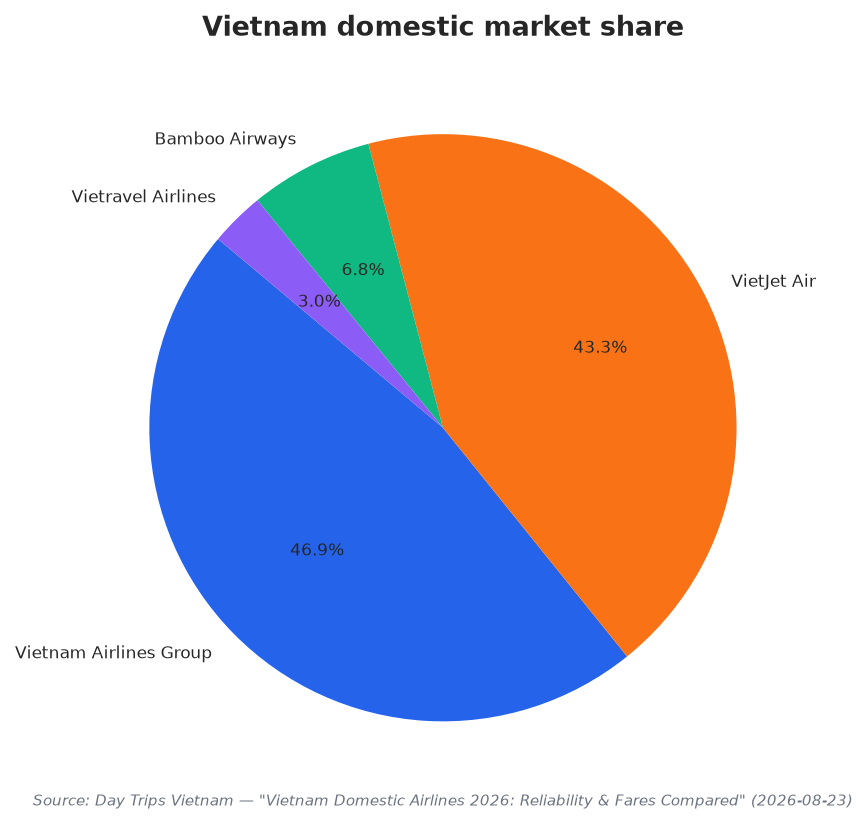
The Vietnam low-cost carrier market sits inside a domestic arena dominated by two giants and defined by price sensitivity. In 2024, Vietnam Airlines Group held 46.9% of the domestic market and VietJet Air held 43.3%, while Bamboo Airways had 6.8% and Vietravel Airlines had 3.0%. Multiple sources describe the big-two structure as durable, with Vietnam Airlines (and group brands) plus VietJet together carrying about 90% of domestic passengers. For travelers, the split is also a product choice: a full-service flag carrier with bundled meals and baggage versus a no-frills model where the base ticket mainly covers a seat and a 7 kg carry-on.
That domestic dominance matters because it funds frequency and aircraft utilization, which then shapes who can credibly expand into short international sectors. Demand has been strong enough to pull the sector toward pre-pandemic levels. In the first half of 2024, Vietnamese airlines transported over 54 million passengers, a sign of a broad rebound. On the country’s busiest city-pair, Hanoi–Ho Chi Minh City, capacity and pricing underscore how competitive pressure and peak demand can coexist: 949,249 seats were available in August 2024 alone, and peak-period ticket prices reached up to USD 140. Another 2026 reliability-and-fares atlas describes the corridor as the world’s 4th busiest domestic route, with 11 million seats in 2025 and a USD 67 average one-way fare, down 11% year over year.
Regional Routes Raise the Stakes for Budget Carriers
Regional flying is where the budget model’s strengths and weaknesses are exposed. A no-frills approach can stimulate demand, but operational disruption can quickly erode consumer trust when schedules are tight. The same Vietnam-focused reliability source documents disruption drivers such as Typhoon Wipha in July 2025, a Tan Son Nhat system failure that caused long delays, and multiple safety-related airfield incidents, including 24 separate laser-targeting incidents in 2024–25 and a June 2025 ground collision at Noi Bai involving two Vietnam Airlines aircraft. In this context, winning regional routes is not only about undercutting fares, but also about sustaining consistent operations when hubs and infrastructure are under pressure.
Carrier strategies are also shaped by who has the breadth to expand and who is still rebuilding. A traveler guide notes that Bamboo Airways has shrunk to a handful of aircraft while it tries to rebuild, while VietJet is positioned as a “bare-bones” low-cost carrier with domestic tickets cited from 600,000 VND (about USD 24), with the base fare typically covering only the seat and a 7 kg carry-on. Meanwhile, Vietnam Briefing notes Bamboo resuming domestic flights to destinations such as Phu Quoc and expanding international operations to Taiwan, while Vietravel Airlines is undergoing strategic transformation following new investments. The same source also points to a planned new full-service carrier expected to launch in 2026 with an initial fleet of six aircraft, adding competitive pressure for routes and airport slots.
Global context helps explain why regional routes are a battleground, but it should not be mistaken for Vietnam-specific metrics. Globally, one forecast states that in 2024 over 1.3 billion passengers opted for low cost carriers, compared with 900 million in 2017, and that Asia-Pacific accounted for more than 450 million low-fare passenger bookings in 2023. Another industry overview highlights how direct online bookings can dominate the model, citing a 93.22% share in 2025 for direct online bookings in the low-cost carrier market it tracks, and it notes that narrowbody jets led with an 82.01% share in 2025. For Vietnam’s airlines, the implication is straightforward: to win regional routes, carriers need scale on narrowbody fleets, a strong digital funnel, and the resilience to keep flights moving when congestion and disruption spike.
How concentrated is the Vietnam low-cost carrier market in domestic flying?
What do the busiest Vietnam routes reveal about competition and fares?
Why are regional routes harder than pure domestic expansion for budget airlines?
Which Vietnam carriers are rebuilding or changing strategy?